

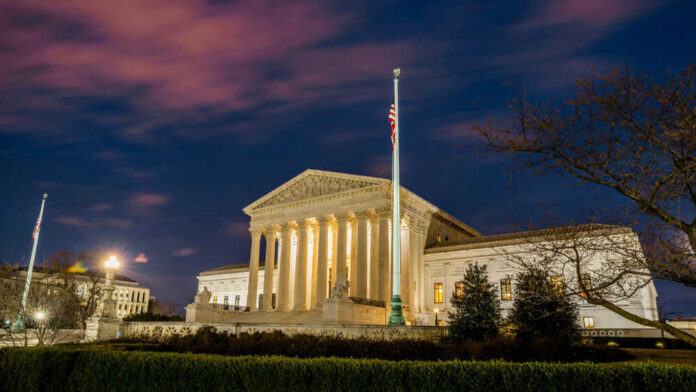
A man with guns, ammunition, knives, and zip ties was found in Justice Brett Kavanaugh’s backyard — and that was just one of hundreds of threats that sent two Supreme Court justices to Capitol Hill with an urgent request for money.
Story Snapshot
- Justices Amy Coney Barrett and Elena Kagan made a rare joint appearance before Congress to request tens of millions in new security funding.
- Threats against Supreme Court justices have surged, with Supreme Court Police anticipating a 38% increase in the current year alone.
- Justice Barrett was personally targeted with a swatting attack at her home, and a bomb threat was called in against her sister’s home.
- Congress approved a $30 million security boost for the Supreme Court, but lower court judges facing similar threats received nothing new.
Two Justices Walk Into Congress With a Warning
Justices Barrett and Kagan sat before lawmakers on July 14, 2026, in one of the rarest events in American civic life — a sitting Supreme Court justice testifying on Capitol Hill. The last time justices appeared before Congress was in 2019.
The fact that two of them showed up together, from opposite ends of the ideological spectrum, sent a clear signal: the threat environment around the nation’s highest court has become serious enough to set aside the usual separation between branches.
Their ask was direct. The judiciary formally requested over $900 million for security across the federal court system, a $29 million jump from the prior year, with nearly $15 million earmarked specifically for Supreme Court justices and their families.
The court’s own budget documents stated plainly that “ongoing evaluations of threats reveal changing risks that necessitate ongoing protection.” That is not bureaucratic boilerplate. That is a warning.
The Threats Are Real and They Are Getting Worse
Justice Kagan put hard numbers on the problem during her testimony. Supreme Court Police anticipated a 38% rise in threats for the current year, following a 25% increase the year before.
The Capitol Police chief separately told lawmakers that threats against members of Congress rose 50% in the same period. These are not vague feelings of unease — they are tracked incidents logged by law enforcement agencies that exist specifically to monitor this kind of danger.
The specific incidents are even more alarming than the statistics. An armed man from California was found in Justice Kavanaugh’s backyard carrying guns, ammunition, knives, and zip ties. Another individual was arrested on Capitol grounds asking where to find the Supreme Court.
Justice Barrett described a swatting attack at her own home — a false report of gunfire designed to send armed police rushing to her door — and a bomb threat called in against her sister’s residence. These are not online rants. These are physical, coordinated acts of intimidation against sitting justices.
A Pattern That Goes Back Years, Not Months
This is not a new problem that appeared overnight. The 2020 fatal attack on a family member of a federal judge in New Jersey was a turning point that first pushed Congress to take judicial security seriously. Since then, the numbers have kept climbing.
The U.S. Marshals Service reported 560 threats against federal judges in one recent year, followed by 166 more in just the months since October 2025. The threat curve is moving in only one direction.
The leak of the Dobbs decision in 2022 made things worse. Justices’ home addresses became targets. Protesters showed up at their residences. Personal security, previously limited to the Chief Justice, was expanded to cover all nine justices.
The court has since asked for funding to design a new visitor screening facility outside the building itself — a physical acknowledgment that the current setup was built for a different era.
Congress Acted, But Only Halfway
Congress approved a $30 million security boost for the Supreme Court, tucked into a broader spending bill that ended a 43-day government shutdown.
That money matters. But it came with a glaring gap: lower court judges who testified about facing the same rising threats received no new funding at all.
Federal district and appeals court judges handle thousands of cases involving violent criminals, drug traffickers, and domestic terrorists. Leaving them without additional protection while funding only the Supreme Court is a choice that deserves scrutiny.
Justices Elena Kagan and Amy Coney Barrett pitched increased security funding for the Supreme Court next year at a pair of rare congressional hearings for sitting justices Tuesday that covered issues ranging from emergency cases to judicial ethics.https://t.co/KBGpgFlXmC
— Roll Call (@rollcall) July 14, 2026
The $30 million boost also remains stalled in the Senate as of late March 2026, tied up in unrelated immigration debates rather than any genuine dispute about whether the threats are real.
No one has produced evidence challenging the core facts — not the swatting attack, not the armed man in Kavanaugh’s yard, not the documented surge in threat statistics. The case for protecting the justices is solid. The case for leaving the rest of the federal judiciary exposed is much harder to defend.
Sources:
cbsnews.com, cnn.com, aol.com, reuters.com, politico.com, nytimes.com