
President Trump’s new mail-in voting executive order is already colliding with the Constitution’s division of power—setting up a court fight that could reshape election rules right before the midterms.
Story Snapshot
- Trump signed an executive order on March 31 directing new federal steps on absentee voter lists, ballot delivery, record retention, and investigations tied to ballot distribution.
- Multiple lawsuits—led by Democrats and a coalition of states—argue the order unlawfully intrudes on state-run election authority.
- Two Republican election officials publicly predicted courts will block the order quickly, warning it could create confusion for voters and administrators.
- The White House says the order strengthens election integrity, while critics argue it injects federal power into rules the Constitution largely reserves to states.
What the Executive Order Directs Federal Agencies to Do
President Trump’s March 31 executive order directs the federal government to take several steps affecting the administration of mail-in voting.
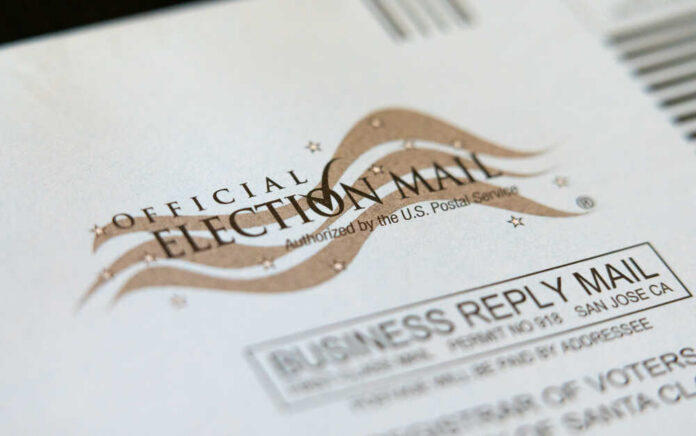
Reporting indicates the order calls for creating a national list of approved absentee voters and instructs the U.S. Postal Service to deliver ballots only to verified voters.
It also requires preserving election records for five years and tasks the Attorney General with investigating wrongful ballot distribution.
Trump signs order tightening mail-in voting, drawing swift legal threats https://t.co/Ee1Xy5Bml2
— Reuters Legal (@ReutersLegal) April 1, 2026
The practical impact of those directives depends on whether courts allow them to take effect and how agencies interpret “verified” status across different state systems.
Many states already use identity checks, ballot tracking, and absentee voter procedures that differ by state law.
That mismatch—federal rules applied over fifty separate election codes—is a central reason critics say the order risks administrative turmoil heading into 2026 voting.
Republican Election Officials Break Ranks on Constitutionality
Pennsylvania Secretary of the Commonwealth Al Schmidt, a Republican, and former Maricopa County Recorder Stephen Richer, also a Republican, said publicly that the order is likely to be struck down.
On ABC News’ “This Week,” they framed the order as unnecessary in places where verification systems already exist and predicted courts would move fast.
Their core argument tracks long-standing constitutional limits that place election administration primarily with the states.
Those warnings matter because they come from officials who have run elections in two politically contested states—Pennsylvania and Arizona—where debates over mail voting have been intense since 2020.
Their comments also highlight a tension conservatives often recognize: securing elections is a legitimate goal, but pursuing it through the wrong branch of government can backfire.
If courts view the order as executive overreach, the result could be another costly, high-profile legal defeat that leaves election rules less clear.
The Lawsuits: States, Party Leaders, and Advocacy Groups Move Fast
By early April, at least four lawsuits had already been filed against the order, including legal actions tied to Senate Minority Leader Chuck Schumer and House Minority Leader Hakeem Jeffries, as well as challenges involving the Democrat Party, the DNC, and the ACLU.
A separate multistate effort involves 23 states, including Arizona and Pennsylvania, under Democrat Governor Josh Shapiro, with Democrat attorneys general filing in federal court.
As of April 6, no court rulings had been reported, and litigation remained in its early stages. Plaintiffs broadly argue the order violates constitutional structure—especially the idea that states set the rules for conducting elections—while the administration defends it as an election-integrity measure.
The immediate political reality is that lawsuits can freeze implementation through injunctions, leaving states and voters in limbo as deadlines for printing, mailing, and verifying ballots approach.
Why the Constitution’s State-Federal Divide Is at the Center
The constitutional fight centers on Article I, Section 4, which gives states the primary authority over the “Times, Places and Manner” of holding elections, while allowing Congress—not the president acting alone—to alter certain regulations.
Critics cited in reporting argue that a presidential directive reshaping ballot delivery or absentee eligibility steps into territory reserved for state legislatures and election officials.
That’s the legal vulnerability Republican officials pointed to when predicting the order would be blocked.
Conservatives who prioritize limited government should pay attention to the method, not just the message.
Election integrity is a valid public interest, but courts tend to scrutinize unilateral executive action that bypasses Congress and overrides state processes.
If the goal is durable reform, legislation is harder but more defensible. Otherwise, the country stays trapped in a cycle of whiplash—new rules announced, lawsuits filed, and judges deciding core policy weeks before ballots go out.
Integrity vs. Confusion: What Happens Next for Voters
Supporters of tighter controls argue that better verification can build confidence, especially after years of distrust.
But the available sources also describe a competing risk: when rules change abruptly and states must reconcile federal demands with their own systems, voters receive mixed signals about eligibility, deadlines, and ballot handling.
Even critics who favor secure elections warned that the order could “sow confusion,” which could depress participation and create openings for further legal challenges.
For now, the clearest fact is procedural: judges, not campaign ads, will decide whether the order can operate before the midterms.
The White House says the intent is to protect election integrity; opponents say it is unlawful and disruptive.
With no rulings yet, Americans are left watching the courts to see whether the administration’s approach survives scrutiny—or becomes another example of Washington trying to solve a state-run problem with a sweeping federal directive.
Sources:
https://www.cpr.org/2026/03/31/trump-executive-order-mail-in-voting/
https://www.newsmax.com/politics/trump-mail-invoting/2026/04/05/id/1251909/
https://www.brennancenter.org/our-work/research-reports/status-trumps-anti-voting-executive-order