

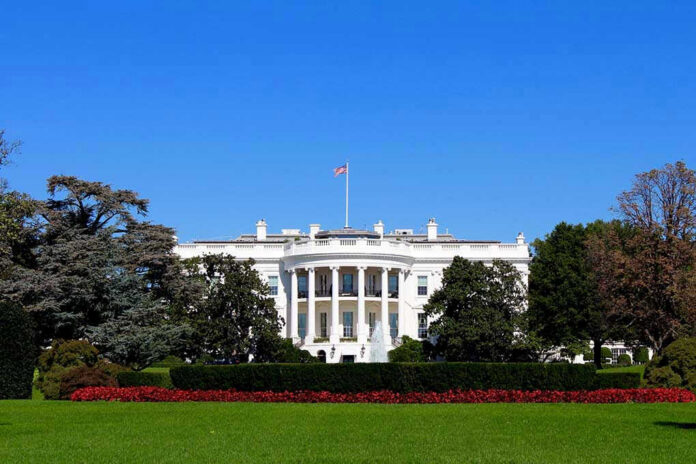
President Trump’s plan to use a privately funded “Great Ballroom” for future inaugurations is reigniting a core Washington question: who controls America’s most important civic ceremony—and where it should happen.
At a Glance
- President Trump announced on Feb. 10, 2026, that the new White House “Great Ballroom” will be used for future presidential inaugurations.
- The project is estimated at $300 million and is funded entirely by private donors, with the White House reporting that construction is ahead of schedule.
- The expansion is tied to a major East Wing modernization that included demolition, drawing a legal challenge from the National Trust for Historic Preservation.
- The Constitution mandates the language of the inaugural oath but does not specify the ceremony’s location, leaving the venue decision largely tradition-based.
Trump’s Inauguration Signal Shifts a Modern Tradition
President Donald Trump posted on Truth Social to share new renderings of the White House “Great Ballroom” and said the venue “will also be used for future Presidential Inaugurations.”
Modern inaugurations have typically been staged on the U.S. Capitol’s west front, but the new statement points to a possible long-term shift. The administration also highlights structural, safety, and security features as a rationale for the change.
President Trump posted new renderings of his "Great Ballroom" and said it "will also be used for future Presidential Inaugurations."
Read more: https://t.co/PkStwyx4tE pic.twitter.com/KR7DAeHZY9
— ABC News Politics (@ABCPolitics) February 10, 2026
Trump’s phrasing leaves an important detail unresolved: whether he is describing a preferred option for future presidents or setting a new default for the country.
Public reporting summarized in the research does not include formal agreements with Congress or the Joint Committee on Inaugural Ceremonies, which typically coordinates the Capitol-side proceedings.
With limited public detail so far, the announcement functions more as a direction of travel than a finalized operational plan.
A $300 Million Ballroom Built with Private Donor Money
White House officials first announced the ballroom plan in July 2025 with an initial estimate of $200 million, later expanding the scope and finishes and raising the total to $300 million.
The administration says the cost is covered entirely by private donations rather than federal appropriations, a point likely to resonate with taxpayers weary of Washington’s spending habits. Trump has also said the project is on budget and ahead of schedule.
The project is designed as a large event space to address long-standing capacity limits inside the White House complex. Press Secretary Karoline Leavitt said presidents and staff have sought a larger venue for roughly 150 years, because the existing East Room constraints limit state dinners and major ceremonies.
Reported design figures describe a roughly 90,000-square-foot expansion overall, with the ballroom itself estimated at around 25,000 square feet, and seating capacity varying by configuration.
East Wing Demolition Sparks Preservation Lawsuit and Court Scrutiny
The most contested aspect is not a chandelier or guest list—it is the demolition and replacement tied to the historic East Wing. Construction began in September 2025, and the East Wing was fully demolished by October, according to the compiled timeline.
The National Trust for Historic Preservation filed a lawsuit seeking to halt the demolition and construction, reflecting broader concerns that modernization is being prioritized over the preservation of historic structures on the White House grounds.
A federal judge signaled in January 2026 doubts about the Trump administration’s legal authority regarding the renovation plans and the use of private funding, with a decision expected in February 2026.
The research does not provide the full legal briefs or final ruling, so the public is largely left with a high-level view: a major construction project, funded outside the usual appropriations process, is proceeding while a preservation challenge questions whether the executive branch can move that fast on a historic site.
What the Constitution Says—and What It Doesn’t
Under the Constitution, presidents must take a specific oath, but the founding document does not require the ceremony to happen at the Capitol or anywhere else.
The Library of Congress has emphasized that the location is not constitutionally mandated, and history shows that inaugurations have occurred in multiple places across different eras.
That legal reality gives presidents flexibility, but the civic symbolism still matters because inaugurations serve as a public ritual of constitutional continuity.
Moving the ceremony to the White House would change the visual balance between the branches: the Capitol symbolizes the legislature and the people’s representatives. In contrast, the White House symbolizes executive power.
Supporters may focus on security, access control, and modern facility needs; critics may argue that it narrows public participation or sidelines Congress’s traditional role in the event. The research does not include statements from congressional leaders, so the political temperature on Capitol Hill remains unclear.
Security, Accessibility, and the Unanswered Logistics
Even if legally permissible, shifting inaugurations would require practical coordination that has not yet been publicly spelled out. Crowd size, press positions, parade routes, public viewing areas, and inter-branch protocol would all need to be reworked if the focal point shifts from the Capitol steps to the White House ballroom.
The available reporting summarized in the research does not include a detailed operational blueprint, leaving many questions about accessibility for ordinary Americans who view inauguration day as their day, too.
Trump says his 'Great Ballroom' will be used for 'future Presidential Inaugurations' https://t.co/01eYDYBnYo
— KMET1490AM (@KMETRadio) February 10, 2026
For now, the clearest facts are straightforward: the Great Ballroom is a major, privately donor-funded construction project on the White House grounds, with its scale and finishes expanded since mid-2025, and it is tied to an East Wing modernization now facing legal and judicial scrutiny.
Trump’s inauguration remark raises the stakes by turning a facilities upgrade into a debate over national symbolism—one that courts and logistics will ultimately shape, and by whether future presidents use the venue.
Sources:
Trump says his ‘Great Ballroom’ will be used for ‘future Presidential Inaugurations’
Trump says his ‘Great Ballroom’ will be used for ‘future Presidential Inaugurations’
Trump says his ‘Great Ballroom’ will be used for ‘future Presidential Inaugurations’
‘On budget and ahead of schedule’: Trump shares another rendering of White House ballroom
Trump says Great Ballroom will be used for future presidential inaugurations