
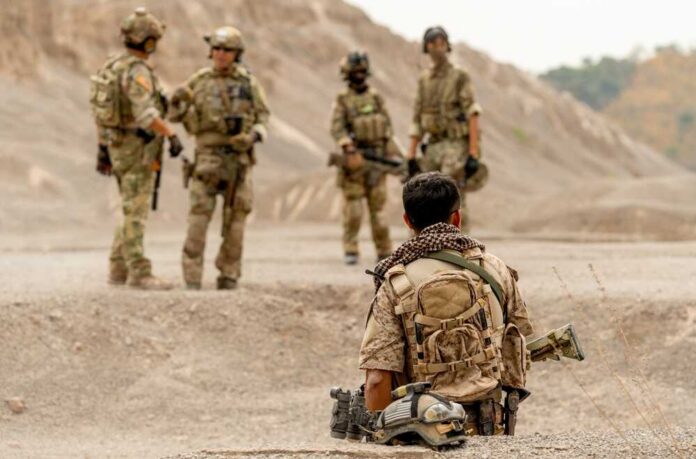
America is sending about 200 troops into Nigeria—but this time the mission is narrowly defined as “training only,” raising fresh questions about how Washington avoids another open-ended foreign entanglement while fighting jihadist terror.
Story Snapshot
- Nigeria says it will host roughly 200 U.S. technical and training personnel to help its military fight extremist violence, with no U.S. combat role.
- Nigerian Defense Headquarters says Nigerian forces will keep full command authority, signaling an invited, sovereignty-respecting partnership.
- The deployment follows U.S. airstrikes on IS-affiliated militants in northwest Nigeria in December 2025 and confirmation of a small U.S. intelligence support team in January 2026.
- Nigeria’s insurgency has raged since 2009, involving Boko Haram, an ISWAP splinter, kidnapping “bandit” networks, and newer Sahel-linked threats like JNIM.
What Nigeria Says the U.S. Mission Will (and Won’t) Do
Nigerian authorities announced that the United States will deploy about 200 troops to Nigeria as technical and training personnel, explicitly described as non-combat support.
Nigeria’s Defense Headquarters spokesman, Maj. Gen. Samaila Uba said Nigerian forces will retain complete command authority, an important detail meant to head off perceptions of foreign takeover or direct intervention. A U.S. official speaking anonymously said the contingent should arrive soon after the announcement.
The limited scope matters because “training” deployments can either stay contained or quietly expand once the realities of war set in. The available reporting does not specify exact arrival dates, where the trainers will be based, or what units they will advise.
Those unknowns are not trivial: mission clarity is the difference between helping a partner develop competence and drifting into responsibility for outcomes Washington does not control.
About 100 U.S. troops plus equipment have arrived in Nigeria to help train soldiers in the West African country as the government fights against Islamic militants and other armed groups, the Nigerian military announced Monday.https://t.co/mn2J29gSLP
— 7News Boston WHDH (@7News) February 16, 2026
Why Nigeria’s Security Crisis Keeps Pulling Outside Help
Nigeria has struggled with insurgency and mass-casualty violence since 2009, with Boko Haram and its Islamic State West Africa Province splinter among the most notorious threats.
The conflict has also widened beyond a single terror group into overlapping turf battles among armed factions, including kidnapping rings often described as “bandits” and newer extremist actors pushing in from the Sahel. United Nations-linked data referenced in the reporting attributes thousands of deaths to the protracted crisis.
The violence is concentrated in Nigeria’s largely Muslim north, and analysts cited in the reporting say most victims are Muslims, even as Christian communities have also been targeted and terrorized.
That distinction matters for Americans trying to understand the conflict without propaganda filters: the facts point to a broad breakdown in security affecting ordinary families across faith lines. The core problem described is insufficient protection and weak territorial control as armed groups multiply and adapt.
How This Deployment Fits Trump-Era Counterterror Strategy
The new training deployment comes after several U.S. actions that signal a more active counterterror posture than many voters associated with the prior administration’s approach.
In December 2025, the United States conducted airstrikes on Islamic State-affiliated militants in northwest Nigeria. In January 2026, U.S. Africa Command confirmed that a small U.S. intelligence support team was present in the country. The February announcement now adds a larger footprint, though still framed as non-combat.
President Trump previously accused Nigeria of failing to protect Christians from “genocide,” a claim the Nigerian government rejected. At the same time, analysts quoted in the reporting argue that the situation is more complex than a single faith-based narrative.
Taken together, the record shows two realities at once: Americans are right to care about persecuted Christians, and it is also essential to accurately describe who is being killed and why. Sound strategy starts with clear-eyed facts, not slogans.
The Constitutional and “No Boots on the Ground” Tension
For many conservative readers, the key issue is not whether jihadist groups are dangerous—they clearly are—but whether U.S. involvement stays within a defined mission that serves American interests.
Training missions can be prudent when they strengthen a partner’s capacity and reduce the need for repeated U.S. strikes. They can also become a pathway to deeper engagement if local forces falter, if trainers are threatened, or if political pressure grows to “do more.”
The reporting stresses that Nigeria invited U.S. personnel and will retain command authority, which reduces the appearance of an occupation and respects national sovereignty.
Still, the lack of detailed public parameters—duration, basing, force protection rules, and end-state—leaves Americans without a full picture of the commitment being made. In a post-Iraq and post-Afghanistan era, voters have learned to ask whether “limited” missions stay limited, and what triggers an expansion.
What to Watch Next as Trainers Arrive
Several practical questions will determine whether this deployment remains a focused partnership or turns into a recurring escalation. The first is whether the trainers’ efforts translate into measurable improvements against multiple threats, including Boko Haram, ISWAP, kidnapping networks, and newer Sahel-linked groups such as JNIM, which reportedly claimed its first Nigerian attack in 2025. The second question is whether Nigeria can protect civilians and regain control of contested areas without shifting the burden to U.S. forces.
U.S. troops arrive in Nigeria to help train its troops, Nigerian military says https://t.co/8NibmWWD0j
— don85375 (@don85375) February 16, 2026
The third question is transparency: Americans will want clear explanations of what the U.S. personnel are permitted to do, how success will be judged, and how long the deployment will last.
The sources available so far describe the mission as training-only, with no combat role, but provide limited operational detail. If updates emerge about basing, timelines, or mission expansion, those details will shape whether this looks like prudent counterterror cooperation—or the early stages of another open-ended commitment.
Sources:
US Will Send Troops to Nigeria to Train the Military to Fight Extremism