

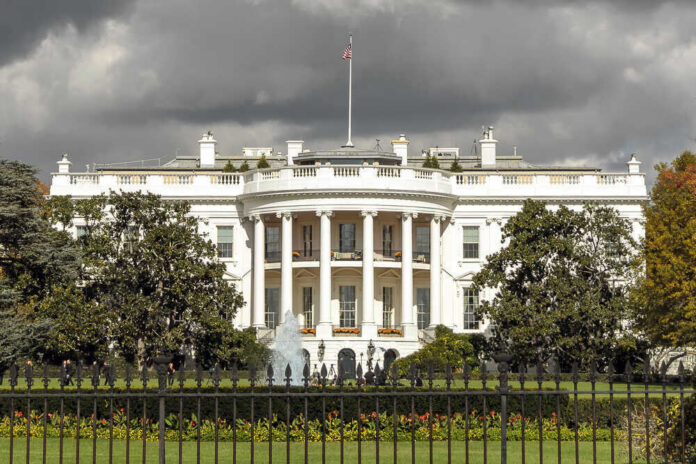
President Trump’s surprise disclosure of a classified military complex being built under a new White House ballroom has ignited a new fight over secrecy, security, and who really controls changes to America’s most famous building.
See the video below.
Story Snapshot
- President Trump said the U.S. military is building a “massive” underground complex beneath a planned White House ballroom on the former East Wing site.
- Trump said the $400 million ballroom is privately funded and designed to be bulletproof and “drone-proof,” functioning as a protective shield above the facility.
- A lawsuit from the National Trust for Historic Preservation challenges whether required reviews and approvals were bypassed before demolition and construction.
- Key details about the underground facility remain classified, limiting independent verification and raising transparency questions.
Trump’s Disclosure: A Ballroom Above a Classified Build
President Donald Trump told reporters on March 30, 2026, that the military is constructing a “massive” underground complex beneath a new White House ballroom planned for the footprint of the former East Wing.
Trump described the above-ground project as a $400 million addition and argued the structure’s hardened design—described as bulletproof and resistant to drone threats—would help protect what is being built below.
Trump also insisted the ballroom is being financed with private money, not taxpayer dollars, and said construction is ahead of schedule and under budget.
The project has been framed by the administration as both a practical fix—expanding space for major events and visiting dignitaries—and a security upgrade in an era when drones and other asymmetric threats are increasingly common. The White House has not released technical specifications.
BELOW THE SURFACE: President Trump reveals the U.S. military is building a "massive complex" beneath the planned, privately-funded White House ballroom, and that construction is "ahead of schedule." pic.twitter.com/VDbepFqox8
— Fox News (@FoxNews) March 30, 2026
What’s Known—and What’s Still Classified—About the Underground Facility
Public information about the underground complex remains thin by design. Reporting on Trump’s remarks confirms the president acknowledged the facility and described it as military-built, but the purpose, footprint, capabilities, and timeline are largely undisclosed.
One outlet noted it could not independently confirm the complex’s construction and said it remains unclear what the underground space would include. That uncertainty is central to the debate.
The situation is further complicated by questions surrounding existing White House emergency infrastructure. The Presidential Emergency Operations Center (PEOC) was historically located beneath the East Wing area, and the East Wing was demolished in October 2025 to make way for the ballroom project.
The current status of the prior facility after demolition has not been clearly established in public reporting, leaving Americans to piece together how continuity-of-government needs are being addressed.
Legal Challenge: Preservation Law vs. Executive Security Authority
The National Trust for Historic Preservation filed suit in December 2025, arguing the administration bypassed required review steps and approvals tied to historic preservation and related processes.
A federal judge declined to pause construction early in the case, and a decision on an amended complaint was expected by the end of March 2026, though available reporting does not confirm a final ruling. The court fight now sits alongside the national security storyline.
Justice Department lawyers have argued that security considerations should weigh heavily when courts consider whether to halt work. The administration’s broader defense is that presidents have long modernized the White House and that the executive branch has legal authority to make security-related changes.
For voters who endured years of Washington bureaucracy expanding into everyday life, this case tests a different question: where legitimate security ends and procedural guardrails begin.
Private Funding, Public Trust, and the Risk of политicking Around Security
Trump’s claim that private donors are covering the ballroom’s $400 million cost has fueled two parallel reactions. Supporters see a benefit in keeping major renovations off taxpayer balance sheets, especially after years of overspending and inflation fears tied to fiscal mismanagement.
Critics have raised concerns about donor influence and optics, with Democrats describing the arrangement in sharply negative terms. The identities of donors have not been detailed in the provided reporting.
White House Press Secretary Karoline Leavitt has confirmed military “upgrades” to White House facilities while declining to provide additional detail, citing classification.
That restraint is normal for sensitive security work, but Trump’s own public description of a “massive” complex creates an unavoidable tension: the administration wants operational secrecy, yet the president has put the existence of the facility into public view. The result is intensified curiosity and more political heat.
What Happens Next: Courts, Construction, and Oversight Questions
Construction on the ballroom and the underground project was reported as active as of late March 2026, but the legal dispute could still reshape timelines if the court ultimately demands additional reviews. Another unresolved issue is Congress’s posture.
While the lawsuit references questions about congressional authorization, available reporting does not show Congress formally stepping in with a clear approval or prohibition. That gray area may persist unless lawmakers force an oversight moment.
For conservatives focused on constitutional boundaries and limited government, the cleanest outcome is a process that protects classified capabilities without treating the public as an afterthought.
The strongest facts on the table today are Trump’s own statements, the existence of ongoing litigation, and the reality that major details remain unverified due to classification. Until courts and the administration clarify more, the story will remain a mix of confirmed construction above ground and unanswered questions below it.
Sources:
Trump Reveals Military Building “Massive Complex” Beneath Planned White House Ballroom
Trump says ‘massive’ military complex to be built beneath White House ballroom
Trump says military building ‘massive complex’ beneath new White House ballroom
President Trump says military building complex under future White House ballroom construction
Trump claims donor-funded White House ballroom includes hidden build below, security focus