

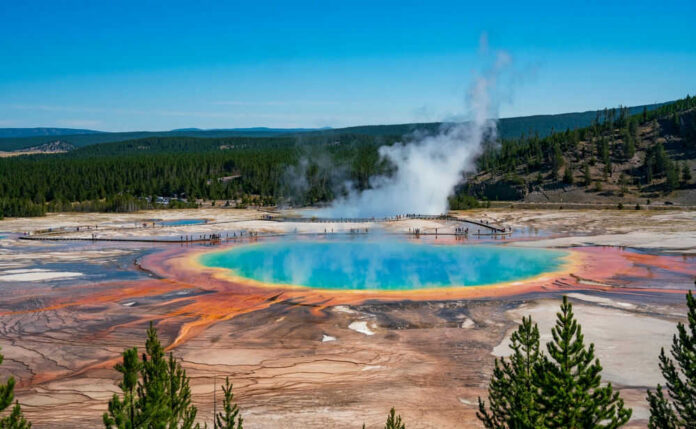
After five years of silence, the world’s largest acidic geyser at Yellowstone has roared back to life, reminding Americans that nature’s power dwarfs government bureaucracy and that our national treasures deserve vigilance over political posturing.
Story Snapshot
- Echinus Geyser erupted approximately 40 times in February 2026 after remaining dormant since December 2020
- USGS confirms the activity is normal hydrothermal behavior, not a volcanic threat to Yellowstone
- Temperature sensors detected water surges reaching 70°C during eruptions lasting 2-3 minutes
- The geyser’s unique acidic water, with pH levels similar to vinegar, distinguishes it from other geothermal features
Geyser Awakens After Extended Dormancy
Echinus Geyser in Yellowstone National Park’s Norris Geyser Basin resumed erupting in early February 2026 after a five-year dormancy. The first recorded eruption occurred on February 6-7, when temperature sensors registered a spike to 70°C.
By late February, the geyser had erupted approximately 40 times, with activity occurring every 2-5 hours between February 16 and 24. The eruptions propel water 20-30 feet into the air for 2-3 minutes, accompanied by a distinct sulfur smell from the highly acidic water.
For the first time since 2020, Echinus Geyser (Norris Geyser Basin, Yellowstone National Park) is erupting! Caldera Chronicles has the details about the show. https://t.co/Ml6NOqyw2W
📷1: Echinus Geyser, seen from above in a photo taken by a research balloon in 2005. The… pic.twitter.com/z4GyqW8xNd
— USGS Volcanoes🌋 (@USGSVolcanoes) March 2, 2026
Scientific Monitoring Confirms Normal Activity
The USGS Yellowstone Volcano Observatory deployed temperature sensors and seismic equipment to track the geyser’s behavior throughout February.
These instruments detected water surges reaching 50°C before the first eruption, providing crucial data about the geyser’s awakening cycle.
The University of Utah Seismograph Stations recorded 74 minor earthquakes in February 2026, with a maximum magnitude of 2.4, consistent with normal park activity. Scientists emphasized that magma remains solid and no caldera unrest has been detected, dispelling concerns about volcanic threats.
Unique Characteristics Set Echinus Apart
Echinus Geyser is the world’s largest acidic geyser, with water pH comparable to vinegar due to unique subsurface chemistry. The geyser’s approximately 20-meter-wide pool is rimmed with silica deposits, a testament to its long geological history.
Unlike predictable geysers such as Old Faithful, Echinus operates on irregular cycles, alternating between active phases and multi-year periods of quiescence. The current activity pattern mirrors behavior observed in late 2017, when similar surges and frequent eruptions occurred before the geyser returned to dormancy.
Park Context and Future Outlook
The Norris Geyser Basin, where Echinus resides, remains one of Yellowstone’s most dynamic hydrothermal areas, powered by volcanic heat that warms groundwater and builds pressure for eruptions.
Recent activity in the region includes a July 2025 uplift that paused by early 2026 and small hydrothermal explosions in late 2024-early 2025 that formed a new blue pool nearby.
The nearby Steamboat Geyser, the world’s tallest, also erupted on February 27, 2026. USGS scientists noted that Echinus exhibited only surges, not full eruptions, after February 24, stating they will monitor whether the geyser remains active or returns to dormancy, as its unpredictable nature makes long-term forecasting challenging.
Tourism and Public Safety Considerations
The geyser’s reawakening has drawn increased visitor interest to Yellowstone, with park officials advising caution near the feature due to its acidic water and sulfur emissions.
No injuries or area closures have been reported, and the National Park Service continues managing visitor access to balance public viewing opportunities with safety requirements.
The USGS’s March 2-3 public announcements helped alleviate initial local concerns by confirming the activity represents normal geothermal system behavior rather than a troubling volcanic sign.
This episode underscores the value of robust monitoring systems that protect both America’s natural heritage and the millions who visit these spectacular sites annually, free from the regulatory overreach that plagued environmental agencies under previous administrations.
Sources:
USGS – Echinus Temperature Record During February 6-7, 2026
India Today – Nature Geyser Yellowstone National Park Eruption
USGS Yellowstone Volcano Observatory – Echinus Geyser is Back in Action
Popular Science – World’s Largest Acidic Geyser Erupts in Yellowstone