
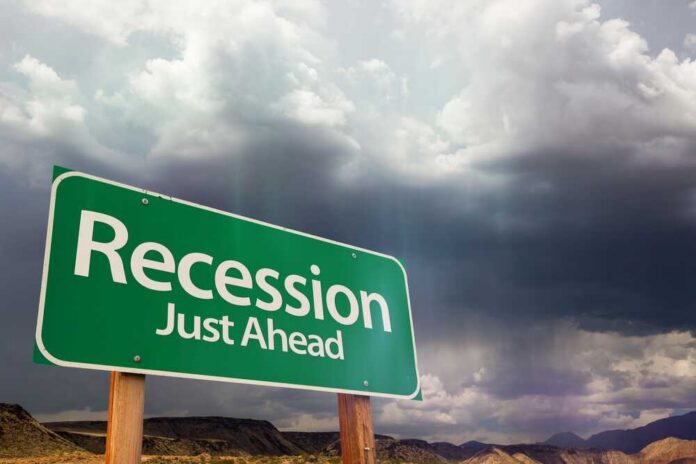
Wall Street bear Albert Edwards warns a single chart signals an inevitable recession in 2026, betraying Trump’s promise to shield American families from economic pain amid skyrocketing war costs.
Story Snapshot
- Unemployment rate breaches three-year moving average, a 100% accurate recession predictor since 1950.
- Polymarket traders price 35% odds of recession by end-2026 despite resilient GDP.
- Sluggish hiring and job openings expose labor market cracks beneath surface strength.
- Tariffs and fiscal stimulus from Trump policies risk inflating CPI to 3.6% mid-year.
- Consumer confidence lags stocks, echoing frustrations with endless spending and foreign entanglements.
Labor Market Signals Breach Recession Threshold
Société Générale strategist Albert Edwards published a chart showing the US unemployment rate crossing above its three-year moving average in early 2026.
This pattern preceded every recession since 1950, occurring in eight instances without fail. Sluggish hiring and declining job openings persist despite strong GDP and consumer spending.
Edwards notes no major forecaster predicts a downturn, yet the chart’s perfect track record demands attention. Families already strained by $3.98 gasoline from the Iran conflict face added risks.
Goldman Sachs just raised US recession odds to 30%, the third bump in 90 days.
Growth is slipping below potential, oil is stuck around crisis levels, and credit is tightening into a weakening jobs market.
This is what the start of a recession actually looks like in real time.…
— StockMarket.News (@_Investinq) March 24, 2026
Polymarket Odds Rise as Yield Curve Steepens
Prediction market Polymarket shows 35% odds of a recession by the end of 2026, defined as two consecutive negative GDP quarters from Q2 2025 to Q4 2026, or an NBER declaration.
Traders imply 65.5% no-recession probability. Treasury yield curve steepens after prolonged inversion, another historical downturn signal.
In November 2025, unemployment was 4.6% and the CPI was 2.7%, pushing the misery index to 7.3%. Policy distortions from 2025 tariffs cloud true baselines, frustrating conservatives seeking fiscal discipline.
Fed and Bank Forecasts Clash with Bear Warnings
Federal Reserve commits to independence, planning two rate cuts in 2026 amid inflation pressures. J.P. Morgan projects 2.2% US GDP growth, dismissing recession threats while noting a policy-driven peak in the CPI at 3.6% mid-year, falling to 2.2% by Q4.
Goldman Sachs forecasts sturdy global growth at 2.8%, with the US leading and 50 basis points cuts. Stanford SIEPR expects modest job growth and stable unemployment. Edwards challenges this optimism as an outlier that bears protecting investors.
Consumer confidence trails euphoric stocks in early 2026. Households risk a rising misery index, workers face job-loss threats, and investors brace for volatility. Equities remain vulnerable to labor weakness, while commodities gain from growth and cuts.
Long-term growth may slip to 1.7% by 2027 without stimulus, weakening dollar. Political fallout from 2025 policies amplifies social strains on families valuing self-reliance over government overreach.
Recession odds climb on Wall Street as economy shows cracks beneath the surface. The economy last year lost more than half a million jobs excluding health care. https://t.co/EtRBaEwfsx
— Jeff Cox (@JeffCoxCNBCcom) March 25, 2026
Historical Precedents and False Signals Heighten Caution
Sahm Rule triggered a false recession signal in August 2024, the first deviation in its history, as GDP proved resilient post-Fed cuts. Eight post-1950 unemployment breaches always led to downturns. The Bureau of Economic Analysis and the NBER hold the final authority on recessions.
Edwards urges caution for equity holders amid policy uncertainties like tariffs. Conservatives question endless fiscal experiments fueling inflation, echoing demands for America First economics over global distractions.
Sources:
One Chart Shows Why a Recession Could Still Be in the Cards in 2026
Polymarket: US Recession by End of 2026
J.P. Morgan: A Baseline Forecast for 2026
Stanford SIEPR: US Economy 2026: What to Watch