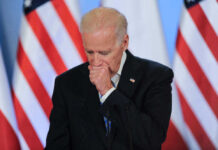

Hakeem Jeffries just rocked Washington by calling President Trump’s chief of staff a “stone-cold racist” and declaring he won’t sit across a table from him.
Quick Take
- Jeffries said Stephen Miller is a “stone cold racist” and refuses to work with him going forward.
- Miller helped shape mass deportation, family separation, travel bans, and birthright citizenship fights during the Trump administration.
- President Trump defended Miller, saying the border required a tough approach.
- Miller has repeatedly denied that racism drives his immigration views, calling his positions law-and-order enforcement.
Jeffries Draws a Line in the Sand
Speaking at a news conference, Jeffries did not soften his words. “Stephen Miller is a stone cold racist,” he said. “His track record speaks for itself, and I’ve got zero interest in working with that kind of individual.” The comment landed as Miller’s profile grew inside the White House, setting up a direct clash between the top House Democrat and one of President Trump’s most powerful aides.
“I’ve made it clear that Stephen Miller is a stone-cold racist. Why would I deal with him at this point in time?”
Speaker-designate Hakeem Jeffries is flatly refusing to sit down with President Trump’s new White House chief of staff, drawing a hard line before he even takes the… pic.twitter.com/eSRfwc5s3Y
— Fox News (@FoxNews) November 22, 2026
Jeffries didn’t stop at a single soundbite. In a later interview, he called Miller “the architect of Donald Trump’s violent mass deportation machine,” tying the label directly to what he described as cruelty, chaos, and death tied to enforcement actions. For Jeffries, the chief of staff job isn’t just a title change. It hands Miller more control over the exact policies Democrats say have hurt immigrant families the hardest.
Miller’s Long Record on Immigration
Miller’s fingerprints show up across some of the administration’s most fought-over immigration moves. Reporting ties him to the push for mass deportations, the effort to end birthright citizenship, travel restrictions on Muslim-majority countries, and the family separation policy from Trump’s first term. Critics also point to earlier emails showing Miller sent white-nationalist material to Breitbart before the 2016 election, material Democrats now cite as proof of motive rather than just policy disagreement.
Miller has pushed back hard against the racism label for years. He has defended family separation as simple rule enforcement, saying it reflected a “zero tolerance policy for illegal entry” where “no one is exempt from immigration law.” He has also argued that asking about someone’s birthplace or criticizing immigration levels doesn’t automatically make a person racist in what he calls a colorblind society. The British Broadcasting Corporation (BBC) reported Miller has flatly denied that bigotry drives him, framing his work instead as carrying out what voters elected Trump to do.
Trump Steps In to Back His Aide
President Trump didn’t let the accusation go unanswered. He told Fox News host Kayleigh McEnany that Miller “was very strong on the border,” adding, “So he called him a racist. But we had to be strong.” That response reframes the fight as one over border security rather than race, a distinction the White House is leaning on hard as Miller settles into his new role overseeing policy and staff.
Miller has used similar logic before when defending restrictions on legal immigration, like the RAISE Act, which favored applicants who speak English. When a reporter questioned that focus, Miller shot back by asking if the reporter had “honestly never met an immigrant from another country who speaks English outside of Great Britain and Australia.” It’s the same pattern: policy framed as merit and law, not ethnicity.
Why the Fight Matters Beyond the Insult
Strip away the headline-grabbing phrase and a real question remains. Did Miller personally drive the harshest outcomes of these policies, or did he operate as one piece of a much bigger machine involving the Department of Homeland Security, Immigration and Customs Enforcement, and the Justice Department? Reporting so far documents Miller’s influence and his past communications, but it doesn’t hand over the internal memos, directives, or sign-offs that would settle exactly who ordered what.
That gap matters for voters trying to judge the claim fairly. Calling someone the architect of a program is different from proving they personally authorized specific harmful outcomes. Conservatives have a fair point when they note that enforcing immigration law, even strictly, isn’t automatically proof of racial animus. But Democrats also have a fair point that Miller’s own past words and writings give them more than just policy disagreement to point to.
What’s clear is that neither side is backing down. Jeffries has made his refusal to engage with Miller a matter of public record, and the White House has made its defense of Miller just as public. With Miller now chief of staff, this standoff isn’t a one-time news cycle. It’s shaping up to be a defining fight over how far political rhetoric can go before it blocks basic governing between the two parties.
Sources:
thegrio.com, thehill.com, aol.com, ournationnews.com, politico.com, bbc.com, usatoday.com