
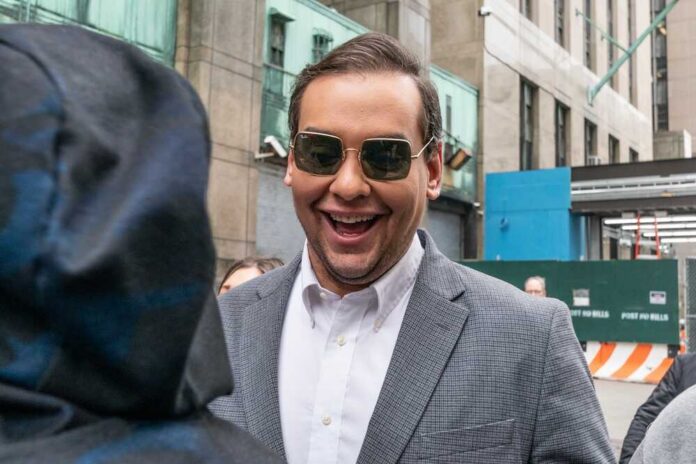
Kalshi made its first-ever lifetime ban count by targeting trades tied to a man’s own seat at the State of the Union.
Story Snapshot
- Kalshi banned George Santos for life and fined him $71,356, citing insider-style conduct.
- The exchange said Santos traded on whether he would attend the address, then tried to sway prices.
- Public posts about attending, then being stuck at an airport, raised fresh questions.
- The Commodity Futures Trading Commission (CFTC) later sanctioned Santos over related activity.
Kalshi’s case: trades, posts, and a lifetime ban
Kalshi said its compliance team found reasonable cause to believe that George Santos used nonpublic knowledge of his State of the Union attendance to trade in a market that depended on his own behavior. The company banned him for life and imposed a $71,356 penalty.
A spokesperson linked the ban to his lack of cooperation with compliance. This was the platform’s first lifetime ban, signaling a hard line on integrity for event contracts.
Kalshi’s disciplinary record, as reported by major outlets, claims Santos placed large trades in a market built around whether he would attend the address. The record also says he then made public statements to influence prices, some of which were false or misleading.
That pairing—self-referential trading and market-moving posts—goes to the core of manipulation risk in prediction markets with thin liquidity and fast-moving sentiment.
What his public posts added to the picture
Public posts heightened the puzzle. Santos said, “I’ll be in the gallery,” days before the address. Later he said he watched from an airport television, which did not match earlier signals. Reporters connected those posts to the alleged trades on his attendance market.
The clash between “I’ll be there” and “I’m at the airport” gave the compliance narrative more bite because price on such markets can swing hard on even small signals.
Skeptics will ask for the raw trade logs, timestamps, and order sizes. That is fair. The public record summarizes the exchange’s findings rather than posting the ledger.
But the strength of the story does not rest on press spin alone. It rests on the exchange’s own surveillance and subsequent federal action that examined nearby facts and imposed sanctions of its own.
The federal follow-through matters
The Commodity Futures Trading Commission ordered disgorgement, a civil penalty, and a three-year trading ban in a settlement linked to the same topic area. Santos did not admit wrongdoing, which is common in such deals.
The fact remains that the federal regulator imposed discipline, which supports the idea that the trading crossed a line under anti-fraud and manipulation rules for event contracts.
Kalshi had already said it detected suspicious activity and referred the matter to the Department of Justice and the Commodity Futures Trading Commission. That exchange-first path matches how regulators now police prediction markets: platforms watch first, then escalate to government.
Santos’s response and the evidence line
Santos blasted the ban as “frivolous nonsense” and called Kalshi “an unserious company.” He told reporters his legal team reached out to the Department of Justice and rejected the insider trading claim as “preposterous.”
He settled with the Commodity Futures Trading Commission “to put this matter behind him,” while his lawyer stressed the deal was not an admission. That defense deserves space, but it does not erase the exchange record and the federal sanctions.
The prediction market Kalshi has announced a lifetime ban against disgraced former Rep. George Santos, who previously settled a regulatory investigation into his trades with a hefty fine and a temporary ban from using prediction markets. https://t.co/ahkspqSAsl pic.twitter.com/5ZsnPYlmQF
— ABC News (@ABC) August 31, 2026
Kalshi’s file, as summarized, alleges that public statements were crafted to push prices in a market he traded. If true, that is not speech; that is a tactic to move a thin order book for gain. Free markets depend on honest signals.
Most traders accept that when you have special knowledge about your own actions, you either keep quiet or keep flat. You do not take a position and then talk your book at the crowd’s expense.
Why this case marks a turning point for prediction markets
Event markets live on fast signals and small pools of capital. That makes them nimble but also fragile. One well-timed post can make a price jump. That fragility is exactly why platforms now treat “who shows up,” “what gets said,” and “when it drops” as sensitive edges.
The move to ban and refer aligns with a wider 2026 push: exchanges as first-line cops, and regulators using anti-fraud tools when old insider rules do not fit neatly.
Kalshi could go further by releasing more detail, within privacy rules, to show the exact sequence of trades and posts. More sunlight would quiet doubts and teach the market what lines not to cross. But the broad lesson already lands.
If you trade on your own actions and try to steer price with posts, you risk a ban on the platform and a bill from Washington. That is not theater. That is how trust is kept.
Sources:
cbsnews.com, npr.org, coindesk.com, abcnews.com, cnbc.com, wsj.com, apnews.com, wmbdradio.com, nbcnewyork.com