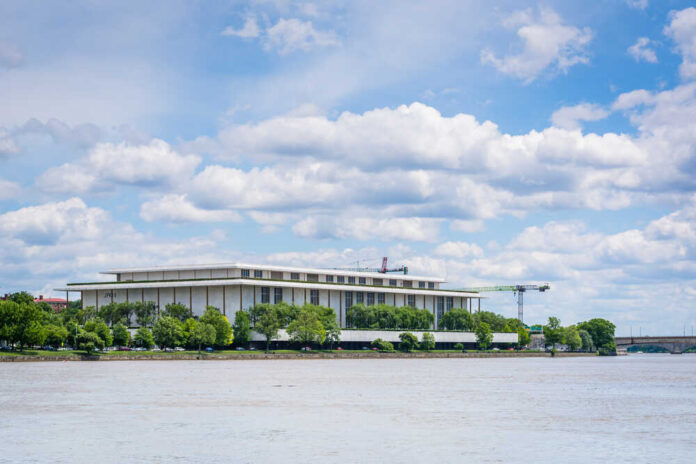
President Trump’s renamed “Trump Kennedy Center” has become the latest battlefield in the war over woke culture, legal authority, and who really controls America’s institutions.
Story Highlights
- Trump’s handpicked board votes to rename the Kennedy Center without waiting for Congress.
- Democrats and Kennedy family members rage, calling the move illegal and insulting.
- Trump allies hail the rebrand as a well‑deserved honor and a reset of liberal arts culture.
- Programming, finances, and attendance at the center are already shifting under Trump’s leadership.
Board Vote Ignites Clash Over Who Controls National Landmarks
This week, President Trump’s handpicked board voted to rename Washington’s flagship performing arts venue the Trump Kennedy Center, immediately updating the center’s online branding before any legal debate could run its course.
The new formal title, The Donald J. Trump and The John F. Kennedy Memorial Center for the Performing Arts, reflects Trump’s role as board chairman and his allies’ desire to put a conservative stamp on a symbol long dominated by liberal arts elites.
Congress originally named the center after President John F. Kennedy in 1964, and legal voices quickly questioned whether a board vote alone could change that.
Former Senate historian Donald A. Ritchie has argued that because Congress created the name in law, only Congress can amend it, meaning any board decision has symbolic power but uncertain legal force. The board nevertheless acted first on branding, underscoring how aggressively Trump’s team is willing to push against entrenched norms.
Trump’s handpicked board votes to rename Washington performing arts center the Trump-Kennedy Center https://t.co/FrXANgYBRg
— The Lowell Sun (@LowellSun) December 18, 2025
Democrats, Kennedys, and the Question of Legal Authority
Democrat leaders immediately framed the decision as an overreach, insisting the board had exceeded its authority. House Democrat leader Hakeem Jeffries, who sits on the board as an ex officio member, stressed that only Congress can legally rename the Kennedy Center, warning that bypassing the legislative process sidelines the people’s branch.
Non‑voting Democrat members echoed that view, labeling the move illegal and portraying the board’s action as another example of Trump testing institutional limits.
Members of the Kennedy family added emotional weight to the backlash, blasting the attachment of Trump’s name to their uncle’s memorial. Maria Shriver called the step “beyond comprehension” and “beyond wild.”
She argued that attaching Trump’s name to the Kennedy legacy is unacceptable and hinted that he might next target other Kennedy memorials or even John F. Kennedy International Airport. Her brother Tim Shriver called the renaming an insult to a great president, framing the move as a cultural provocation, not just a branding tweak.
Trump’s Cultural Counteroffensive Against Woke Arts Establishments
Since returning to office in January 2025, Trump has turned the center into a symbol of his broader crackdown on what he calls woke, anti‑American culture, criticizing past programming as too liberal and vowing to overhaul both the building and its artistic direction.
He has replaced Democrat‑appointed members with loyalists, who then elected him chairman, consolidating control over an institution that once showcased largely progressive voices. For many conservatives, this represents a long‑overdue challenge to an arts world that has often mocked or excluded traditional American values.
White House press secretary Karoline Leavitt celebrated the board’s vote as recognition of what she described as Trump’s unbelievable work on the center since his return, pointing to his push for renovations and a reset in tone.
Trump himself said he was surprised and honored by the decision, praising the board as one of the most distinguished in the country. Well before the official move, he had been informally calling the venue the Trump Kennedy Center, signaling where he wanted the culture to move even before the paperwork caught up.
Renovations, Conservative Support, and Liberal Boycotts
Trump secured more than $250 million from the Republican‑controlled Congress to refurbish the building, promising fresh paint, new theater seats, and broader upgrades that supporters say will modernize a tired facility.
Senator Lindsey Graham touted the renaming as a well‑deserved honor, arguing that Trump has poured his heart and soul into revitalizing the institution. For Trump’s base, these investments demonstrate a commitment to preserving and improving American cultural landmarks instead of allowing them to drift further left under bureaucratic management.
Yet the push has come at a cost in the short term. Reports indicate subscription sales have declined since Trump’s takeover, with rows of empty seats visible during National Symphony Orchestra performances.
Several high‑profile touring productions, including Hamilton, have canceled planned runs, while artists such as Issa Rae and Rhiannon Giddens have scrapped appearances.
Prominent consultants, including Ben Folds and Renée Fleming, resigned, illustrating how deeply left‑leaning segments of the arts community oppose any conservative influence over national stages.
Public Access, Representation, and What Comes Next
Critics argue the board marginalized dissenting voices during the renaming vote, pointing to Representative Joyce Beatty’s claim that she was muted while trying to register concerns remotely.
Center spokesperson Roma Daravi countered that all members, including non‑voting Democrats, were invited to attend in person and were allowed to listen in, emphasizing that voting power rests with the appointed board, not honorary political seats. That dispute reflects a larger fight over who truly represents the public when cultural power is on the line.
Meanwhile, legislation introduced by Republican Representative Bob Order would fully codify a new Trump‑focused name in federal law, but the bill has not yet advanced in committee. Until Congress acts, the center sits in a gray area where branding, politics, and law collide.
For conservatives watching decades of liberal dominance in the arts, the Trump Kennedy Center fight is not just about a marquee; it is about reclaiming institutions, resisting woke narratives, and insisting that American culture reflect the values of the people who built and fund it.