

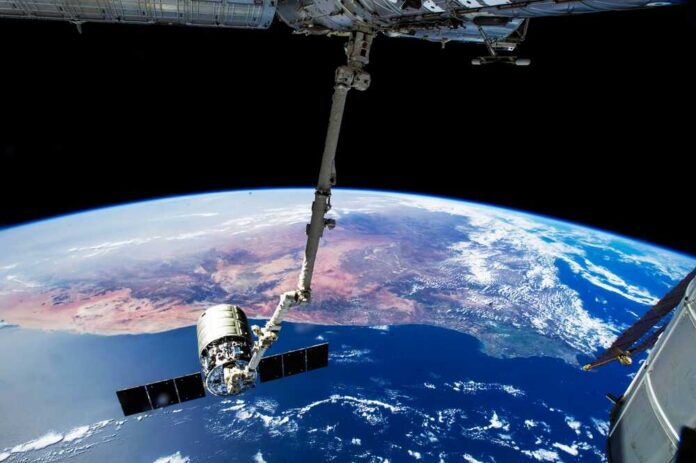
A 1,300-pound NASA satellite is plummeting back to Earth in an uncontrolled descent, reminding Americans how federal agencies operate equipment for years beyond its useful life before losing control—literally.
Story Snapshot
- Van Allen Probe A, weighing 1,323 pounds, re-entered Earth’s atmosphere around March 10, 2026, after nearly 14 years in orbit studying radiation belts.
- NASA projects most of the satellite will burn up, but some components may survive, with a 1-in-4,200 chance of injuring someone on the ground.
- The satellite’s descent accelerated unexpectedly after its mission ended in 2019, due to fuel depletion and the 2024 solar maximum, which expanded Earth’s atmosphere.
- U.S. Space Force is tracking the uncontrolled re-entry, highlighting growing concerns about space debris management as aging satellites fall from orbit.
Uncontrolled Descent After Mission Failure
Van Allen Probe A, launched in August 2012 alongside its twin Probe B, completed its primary mission studying Earth’s radiation belts before running out of fuel in 2019. The satellite lost its sun-pointing capability, ending active operations.
NASA initially projected the probe would remain in orbit until 2034, but the 2024 solar maximum dramatically altered that timeline.
The increased solar activity expanded Earth’s upper atmosphere, creating unexpected drag that pulled the satellite down years ahead of schedule.
This uncontrolled re-entry underscores the limitations of government planning when natural forces exceed predictions, leaving the satellite to fall wherever physics dictates.
1,300-pound NASA satellite re-enters Earth's atmosphere after 14 years in space. https://t.co/TeFeARe9z1
— CBS News (@CBSNews) March 11, 2026
Minimal Risk But No Guarantees
NASA stated on March 9, 2026, assuring the public that most of the spacecraft would burn up during re-entry, scheduled for approximately 7:45 p.m. on March 10, with a 24-hour margin of error.
The agency calculated a 1-in-4,200 risk of debris injuring someone, emphasizing that 70 percent of Earth’s surface is covered by water, making ocean impact most likely.
While the odds seem reassuring, the reality remains that federal agencies launched and operated this satellite without a controlled deorbit plan. Some components are expected to survive the fiery descent, and no one can predict precisely where they will land.
Historically, no injuries from satellite debris have been recorded, but the lack of control over this re-entry highlights the consequences of running missions until fuel exhaustion without contingency plans.
Solar Activity Exposes Government Miscalculations
The accelerated re-entry resulted from solar cycle 25 peaking in 2024, an event NASA acknowledged was “more active than expected.” This expansion of the upper atmosphere increased atmospheric drag on the fuel-depleted satellite, pulling it down faster than models projected.
The Van Allen Probes were originally designed for a two-year mission, but operated until 2019 due to their performance, a testament to the initial engineering. Yet, the lack of propulsion systems to manage post-mission orbital decay left Probe A vulnerable to unpredictable space weather.
Twin Probe B remains in orbit and is expected to re-enter around 2030, offering a comparison case. The incident reinforces concerns about how federal agencies manage aging infrastructure in space, where variables like solar cycles can render long-term projections obsolete.
Space Debris and Federal Accountability
This event occurs amid rising concerns about space debris cluttering Earth’s orbit, with thousands of defunct satellites and fragments posing collision risks.
The Van Allen Probe A’s uncontrolled descent mirrors similar incidents, including NASA’s Upper Atmosphere Research Satellite in 2011 and the European Space Agency’s ERS-2 in 2024, both of which re-entered without incident but highlighted the growing challenge of managing spent hardware.
The U.S. Space Force is tasked with tracking orbital objects and issuing aviation and maritime notifications, a responsibility underscoring national security interests in space traffic management.
While NASA touts the ongoing scientific value of data collected from the Van Allen Probes for space weather forecasting, the lack of a deliberate deorbit strategy reflects a reactive rather than proactive approach.
Future satellite designs must incorporate propulsion for controlled re-entries, ensuring taxpayer-funded equipment doesn’t become unmanaged hazards.
Americans deserve assurance that federal space operations prioritize accountability and safety, not just mission extensions that leave debris falling from the sky.
Sources:
1,300-Pound NASA Satellite To Fall From Orbit, Re-Enter Earth’s Atmosphere – iHeartRadio KFIAM
1,300-Pound NASA Satellite To Fall From Orbit, Re-Enter Earth’s Atmosphere – iHeartRadio WBZ
1,300-pound satellite expected to enter Earth’s atmosphere tonight – ABC News
NASA Satellite Set for Fiery Earth Reentry Tuesday – Evrim Ağacı
NASA satellite crash alert: 1,300-pound spacecraft set for fiery reentry – Economic Times