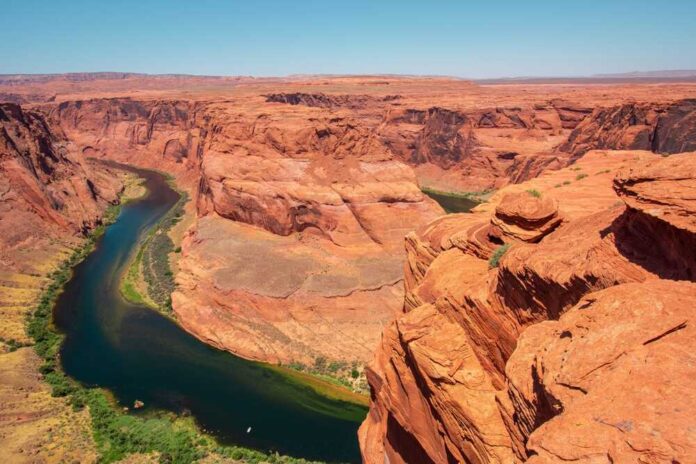
Lake Powell is now just 27 feet above the level where Glen Canyon Dam goes completely dark — and the water is still falling.
Story Snapshot
- Lake Powell sits at roughly 3,524 feet in elevation — only 24 feet above the point where Glen Canyon Dam loses all power-generation capability.
- The reservoir dropped 36 feet in a single year and now holds just 23-24% of its total capacity.
- Federal officials cut water releases from 7.48 million to 6 million acre-feet through September 2026 to slow the decline.
- Projected water flowing into the lake this year is only 34% of the long-term average, making recovery unlikely without major rainfall.
A Reservoir Running Out of Room to Fall
Glen Canyon Dam sits on the Utah-Arizona border and powers homes across the Southwest. The dam needs water at or above 3,500 feet in elevation to spin its turbines.
Right now, Lake Powell sits at roughly 3,524 feet. That gap — about 24 feet — sounds like a cushion. It is not. The lake dropped 36 feet in the past year alone. At that pace, the math gets uncomfortable fast.
Lake Powell, the second-largest reservoir in the U.S. located in Arizona and Utah, is nearing critically low water elevation levels, the latest data shows.
Read more: https://t.co/tYDgXZ8PgR pic.twitter.com/qkqLYovE1l
— ABC News (@ABC) July 14, 2026
The Bureau of Reclamation, the federal agency that manages the dam, responded with emergency action. Officials cut water releases from 7.48 million acre-feet down to 6 million acre-feet through September 2026.
The goal is to buy elevation — roughly 54 feet by April 2027, according to agency projections. That would pull the reservoir back from the edge. But those projections depend heavily on snowpack and rain that simply has not shown up.
The Inflow Numbers Tell the Real Story
The Colorado Basin River Forecast Center issued its May 2026 outlook, and the numbers are stark. Unregulated water flowing into Lake Powell this year is projected at just 3.27 million acre-feet — about 34% of the historical average. That is not a bad year. That is a system running on fumes.
The Colorado River has now been in a historic drought for more than two decades, and the two largest reservoirs in the country — Lake Powell and Lake Mead — have lost 41% of their combined storage since January 2000.
Some experts quoted in news coverage are affiliated with the Glen Canyon Institute, a group founded in 1996 with the explicit goal of draining Lake Powell entirely. Their perspective on worst-case scenarios deserves some skepticism, even when the underlying data they cite is real.
Advocacy groups tend to read data in ways that support their policy goals. That said, the Bureau of Reclamation’s own numbers — not the institute’s — are what make this situation serious.
Dead Power Pool vs. Dead Pool — The Terms Matter
News headlines have used the phrases “dead power pool” and “dead pool” almost interchangeably, creating confusion. The minimum power pool sits at 3,500 feet. That is the level where the dam stops generating electricity.
The actual dead pool — where no water can flow out of the dam at all — sits far lower at 3,370 feet. The lake is nowhere near dead pool. But losing power generation is a serious problem in its own right, affecting electricity for millions of homes across seven western states.
Lake Powell reaching critically low elevation levels, nearing 'dead power pool,' experts say
As of Monday, water levels at Lake Powell measured at 3,524.3 feet above sea level, according to the @USBR tracker. https://t.co/SzEBusvdse
Minimum, or "dead," power pool — in which… pic.twitter.com/p9T8qb8mJw
— Water Mark 🚰 (@OtayMark) July 14, 2026
The Bureau of Reclamation has been careful not to use the phrase “nearing dead power pool” in its official releases. The agency publishes daily elevation data and 24-month operational studies, but it leaves the dramatic language to others.
That institutional caution is actually responsible — but it also leaves a vacuum that advocacy groups and media outlets rush to fill, sometimes with more alarm than precision.
This Has Happened Before, But Not Quite Like This
Crisis warnings about Lake Powell are not new. Officials declared the first-ever Tier 1 water shortage in 2021. They cut releases mid-year in 2022 for the first time in history. By late 2022, both Powell and Mead hit a combined record low of around 25% capacity.
Each time, the federal government stepped in with emergency measures, and each time, the actual worst-case threshold was avoided. That track record gives some reason for cautious optimism.
But there is a difference between 2022 and now. Inflow projections keep getting revised downward. The snowpack that typically refills these reservoirs has underperformed for years.
And the gap between how much water the seven Colorado River Basin states are legally entitled to use and how much water actually exists has never been fully resolved.
The 1922 Colorado River Compact divided water that seemed plentiful in wet years. In the driest stretch of the past 1,200 years, those allocations look like a promise the river cannot keep.
What Happens If the Dam Goes Dark
If Lake Powell drops below 3,500 feet, Glen Canyon Dam stops producing power. That electricity currently serves homes in Wyoming, Utah, Colorado, New Mexico, Arizona, Nevada, and Nebraska. The dam would not break. Water could still pass through lower outlet works, though at reduced capacity.
But the loss of hydroelectric power would push those states to find replacement energy fast — likely at higher cost to consumers. The emergency release cuts buy time. Whether that time is enough depends almost entirely on next winter’s snowfall across the Rocky Mountains.
Sources:
usbr.gov, facebook.com, colorado.edu