
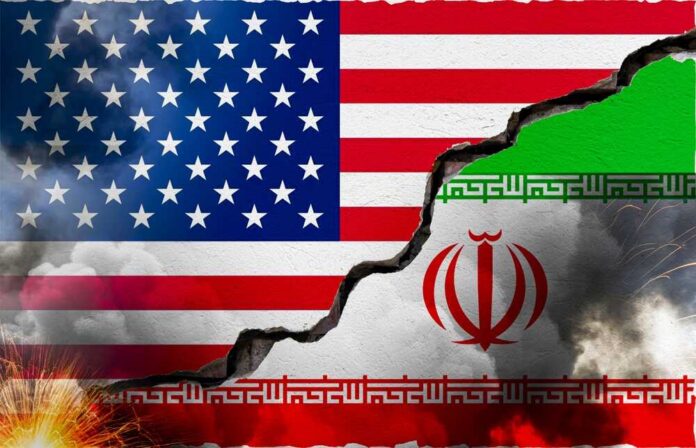
The United States answered Iran’s latest tanker attacks with more than 80 “powerful strikes” that turned the Strait of Hormuz back into the war’s main flashpoint.
Story Snapshot
- U.S. Central Command says Iran hit three commercial ships, breaking a fragile ceasefire.
- American forces struck over 80 Iranian targets, including missile, drone, and small-boat assets.
- Iran denies clear blame and claims it is enforcing shipping control and defending its territory.
- The clash fits a pattern of low-level maritime war that risks a wider conflict and higher energy prices.
U.S. launches new wave of strikes after tanker and cargo ship attacks
United States Central Command said it launched a “series of powerful strikes” against Iran after Iranian forces targeted three commercial vessels transiting the Strait of Hormuz. Officials described the attacks on the ships as a direct violation of a recent ceasefire deal meant to calm the 2026 Iran war.
The vessels included the Singapore-flagged cargo ship M/V Ever Lovely and tankers linked to Qatar and Saudi Arabia, all hit over several days as they moved through one of the world’s most important energy routes.
Central Command framed the operation as punishment for “targeting and attacking commercial shipping crewed by innocent civilians in an international waterway,” language aimed squarely at winning public support and signaling resolve to allies.
The U.S. military said early strikes on June 26 and 27 hit Iranian missile and drone storage locations and coastal radar sites after Iran used a one-way attack drone against Ever Lovely. Washington insisted that ship was following the recommended route from United Kingdom Maritime Trade Operations, countering Iranian claims that it strayed outside agreed lanes.
Targets inside Iran: missile sites, drones, and Revolutionary Guard boats
American officials said the latest round of attacks was several times larger than earlier June strikes, with aircraft hitting air defense systems, surface-to-air missiles, anti-ship cruise missile sites, coastal surveillance systems, drone launch sites, and port facilities along Iran’s southern coast.
Central Command added that more than 60 small boats used by Iran’s Islamic Revolutionary Guard Corps for swarming and harassing tankers were struck to “degrade Iran’s ability to continue attacking international commerce.” Unclassified video released by the command showed one of the explosions labeled as a strike tied to the cargo ship attack.
BREAKING: U.S. Central Command says American forces launched a new wave of strikes Tuesday, hitting more than 80 targets across Iran after Tehran’s latest attacks on commercial vessels in the Strait of Hormuz. The operation targeted Iranian air defenses, command-and-control… pic.twitter.com/cqiZ3wNsMt
— Breaking911 (@Breaking911) July 8, 2026
Iranian state media reported explosions in port cities such as Bandar Abbas and Sirik and on Qeshm Island, describing damage around at least one pier. Tehran said a projectile hit the Sirik area and claimed its naval forces answered by striking United States military locations in the region.
Later statements from the Revolutionary Guard claimed up to 85 American military installations in Bahrain and Kuwait were targeted by missiles and drones, casting their response as a defense of Iran’s Hormozgan province and nearby coastal territory.
Competing stories: ceasefire violation versus defensive enforcement
Washington’s narrative rests on a simple sequence: Iran struck commercial ships despite a signed agreement to reopen the strait, so the United States hit military sites tied to those attacks.
Central Command called Iran’s aggression “unwarranted, dangerous, and a clear violation of the ceasefire,” and President Donald Trump labeled the initial strike on Ever Lovely a “foolish violation” that forced his hand. For many Americans, punishing the attacker and keeping sea lanes open feels like common sense.
Iran has pushed a very different story through state media. Officials said they have the right to control shipping in the Strait of Hormuz, warned Gulf states not to side with Washington, and accused the United States of violating the same agreement by resuming oil sanctions and striking southern Iran.
Iranian outlets claimed at least one vessel ignored warnings and traveled “outside the framework” of new routing arrangements. While Iran has not clearly claimed direct responsibility for all three tanker attacks, its insistence on control and its retaliatory strikes make denial ring hollow to many outside observers.
A familiar pattern in a dangerous maritime chessboard
The clash slots into a pattern that has defined the 2026 Iran war: low-intensity maritime coercion around Hormuz instead of all-out ground war. Earlier in May, Iran and the United States traded fire in the strait, with Iran firing missiles and drones at American destroyers while both sides downplayed damage and blamed the other for breaking the ceasefire.
Think of it as a dangerous chessboard at sea, where each side tests red lines with “retaliatory” hits on ships and coastal sites but stops short of declaring full war.
That pattern has two big costs. First, constant ambiguity about who hit what and when makes it harder for regular citizens to trust any single narrative. Iran’s refusal to fully own the tanker strikes, mixed with U.S. officials limiting details about precise target locations inside Iran, leaves room for doubt that foreign rivals quickly exploit.
Second, every missile and drone in Hormuz shakes oil markets. Reports already note price jumps and renewed volatility after these strikes, a burden that eventually lands on American families through fuel and inflation even if they support strong action.
Sources:
cnbc.com, cbsnews.com, centcom.mil, reuters.com, youtube.com, bbc.com, facebook.com, abcnews.com, wsj.com, en.wikipedia.org, cnn.com