

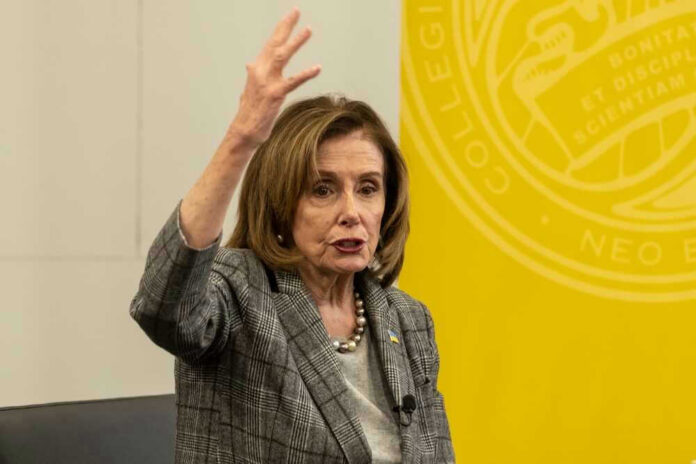
On a podcast, Nancy Pelosi said two Democrats’ Israel views were “wrong,” and the blast line ran straight through her own party.
Story Snapshot
- Pelosi called comments tied to Israel’s Jewish-state legitimacy “more than concerning… it’s wrong.”
- She said those views do not reflect House Democrats and that members would distance themselves.
- Reports linked her critique to remarks attributed to Zohran Mamdani and Abdul El-Sayed.
- Pelosi’s stance arrived as Democrats split over aid and the U.S.-Israel relationship.
Pelosi draws a bright line inside her party
Nancy Pelosi used plain words on Donny Deutsch’s “On Brand” podcast. She was asked about statements tied to Zohran Mamdani and Abdul El-Sayed that questioned Israel’s status as a Jewish state. She answered, “It’s more than concerning. It’s wrong. It’s wrong.” She added that such views do not reflect House Democrats and that members would disassociate from them. Her status as a longtime Democratic leader gave the warning extra weight.
Donny Deutsch framed the test clearly. He said denying Israel the right to be a Jewish state is antisemitic and named the two figures. Pelosi agreed the position was wrong. Reports tied her response to that exact framing. This was not a hedge about policy nuance. It was a moral boundary and a party message about representation. That precision matters because it separates disputes over military aid from arguments about a nation’s identity and right to exist.
What is contested and what is not
The underlying comments from Mamdani and El-Sayed are not presented in full in the coverage. That gap complicates any final judgment on their exact wording. Still, Pelosi made her claim in public and on the record. The best reading is narrow and specific: she reacted to a challenge about Israel’s Jewish character, not a general debate over Israeli policy. That distinction fits common sense and American conservative values about a nation’s right to define itself.
The secondary record on El-Sayed points to a different, though related, fight. He argued that Israel is not a reliable friend of the United States and warned that support can pull America into wars. He opposed United States military aid to Israel. Those are tough claims, but they focus on alliance and funding, not Israel’s right to exist as a Jewish state. Conflating those categories misleads voters and dulls real debate.
Democrats’ split screen on Israel policy
The Democratic caucus has moved into factions on Israel policy. One wing backs robust support. A larger lane seeks conditional aid and sharp criticism of Israeli policy. A smaller bloc wants to end military aid. Recent reporting shows that nearly half of House Democrats have voted to halt aid at points in the last year. Those votes do not equal rejection of Israel’s identity, but they signal a live fight over how America should engage.
Representative Greg Casar underscored the tension. He called for a new approach and for ending the use of American tax dollars to fund Israel’s military. At the same time, he said Israel has a right to exist as a Jewish state. That pairing shows how many Democrats try to hold two ideas at once: affirm Israel’s identity, yet demand changes in policy and accountability. Pelosi’s red line sits upstream from that nuanced space.
Pelosi’s message discipline—and its limits
Pelosi’s statement aimed to protect a party brand in a high-heat moment. She said these views are not what House Democrats stand for. That is a strong institutional claim that invites proof. The caucus has not issued a formal resolution on Israel’s Jewish character, and the vote record is mixed on aid. Still, when a leader this senior draws a boundary, it guides donors, surrogates, and candidates who want national support and swing-district cover.
https://x.com/greg_price11/status/2115983665805062220
Reports also say Pelosi criticized El-Sayed’s Israel stance while still urging support for his bid. That balance looks messy but tracks with political reality. Leaders often separate a candidate’s one issue from the broader ticket. Voters can decide whether that strikes them as prudence or double talk. Either way, the line Pelosi drew—opposing claims against Israel’s Jewish identity—will define how Democrats answer pointed questions in the closing weeks.
Sources:
yahoo.com, nytimes.com, cpr.org, arabcenterdc.org, randall.house.gov, politico.com, edition.cnn.com