

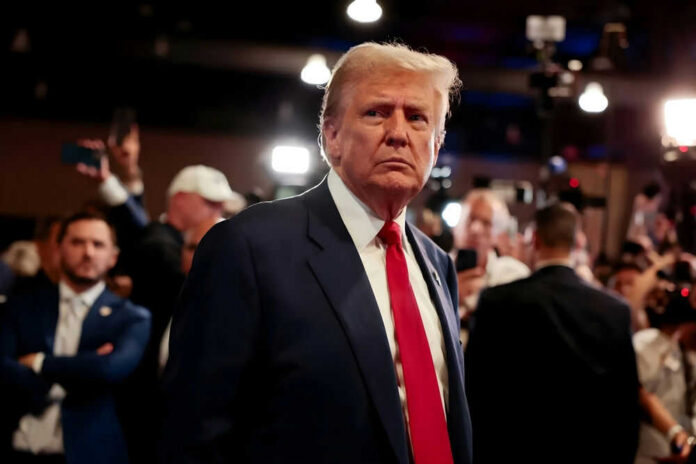
Trump’s new second-term approval low is not just about one ugly number; it is about whether the floor that protected him for a decade is finally cracking.
Story Snapshot
- New York Times/Siena pegs Trump at 37% approval, triggering “new low” headlines and jubilation on the left.
- Polling averages and other national surveys cluster in the high-30s to about 40%, confirming weak but not catastrophic support.[1][4]
- Opponents claim a collapsing presidency; supporters argue biased methods and snapshot noise.
- The real story is whether a long‑standing popularity floor among working‑class and rural voters is starting to erode.
What The 37 Percent Actually Says And What It Does Not
The New York Times/Siena 37 percent approval figure turns into cable-news catnip because it is clean, emotional, and easy to splash on a chyron. The complication starts when that single number gets treated as a medical diagnosis for the entire presidency.
Other data show Trump’s job approval sitting around 36 to about 40 percent nationally during the same period, with disapproval near sixty percent, which makes the 37 percent reading look more like a confirmation of weakness than a shocking outlier.[1][4] Headlines scream; the trend line just shrugs.
Pollsters at FiftyPlusOne, who combine many surveys, estimate Trump’s approval at roughly 36.7 percent with about sixty percent disapproval, a net negative of more than twenty points, while Statista’s summary places him near forty percent earlier in May.[1][4]
Those independent snapshots differ slightly but point in the same direction: the country is more against him than for him, and has been for some time. That is uncomfortable for a president, but it is not new territory. The novelty comes from where he is weakening, not just how low the average sits.
Where Trump’s Coalition Shows Signs Of Fraying
Survey detail paints a sharper picture than any topline. Multiple polls highlight erosion among younger voters, Hispanic voters, and even some of his own 2024 voters, who once backed him almost monolithically and now do so with a little less enthusiasm and a lot more hesitation.[4]
When a president drops among demographics that once powered surprise victories, the concern shifts from “Can he survive bad press?” to “Can he rebuild the winning map?” Conservative voters who care about actually holding power cannot afford to wave that off as media spin.
Data from Pew-style surveys point to a decline in how Americans rate Trump’s personal traits: “keeps his promises,” “uses military force wisely,” and “makes good decisions on immigration” all slide from their post-reelection highs.[4] Many Republicans still approve of his job performance, but the share has ticked downward, especially among younger and Hispanic Trump voters.[4]
That suggests disillusionment on the margins, not mass defection. From a right-of-center perspective, that matters enormously, because close elections are won or lost at those margins while the base assumes everything is fine.
Why A Single Poll Becomes A Proxy War
Critics of Trump quickly weaponize the New York Times/Siena poll as proof of a presidency in free fall, but they rarely dwell on how survey “house effects,” field dates, or question wording can tug a number a few points in either direction.
Trump defenders counter by alleging liberal bias and skewed samples, and they are not wrong that news organizations sometimes frame questions in ways that emphasize controversy. However, no detailed questionnaire, cross tabs, or full methodology from this specific Times/Siena release surfaced in the record, which leaves those arguments long on suspicion and short on verifiable evidence.
Political science research consistently shows that single polls bounce around while the average moves slowly, like a heavy freight train. When media outlets grab one poll with a dramatic low, they often skip the context that the president’s approval has floated in the same rough band for months.[1]
From a common-sense conservative view, the wiser approach is to track the overall lane Trump is driving in, not every pothole. Hitting 37 percent does not automatically mean the car is totaled; it does mean the warning lights are flashing more brightly.
How Much Of This Is Media Narrative Versus Real Danger?
Video commentary from networks hostile to Trump leans hard into words like “stunning,” “collapse,” and “record low,” and some pundits happily extrapolate a 37 percent approval figure into predictions of inevitable defeat.[2][3] That leap outruns what the numbers can legitimately support.
Approval in the high-30s to around 40 percent is bad but not historically unique, and it does not bar a president from winning if the opposition fractures or the issue environment shifts. Treating one poll like prophecy violates both statistics and common sense.
Trump approval rating hits second-term low in new pollinghttps://t.co/05kx1RraoA
— The Hill (@thehill) May 18, 2026
At the same time, serious conservatives should resist the comforting story that every unpleasant survey is just “fake news.” The convergence of independent data sources at roughly the same low level indicates a genuine public sourness on Trump’s job performance, not a mirage.[1][4][5]
A movement that dismisses all unfavorable information loses the ability to self‑correct. The wiser instinct, anchored in traditional right‑of‑center realism, is to ask: what are voters telling us, and how do we earn back their trust without surrendering core principles?
Why The Polling Floor Matters More Than The Exact Number
Trump’s political resilience for years rested on a sturdy approval floor in the low-40s, especially strong among non‑college, rural, and evangelical voters. The current batch of surveys suggests that floor may now sit a few points lower, closer to the upper 30s, and that he has started to lose a slice of the “reluctant but hopeful” voters who once gave him the benefit of the doubt.[1][4][5] If that shift holds, Republicans face a blunt arithmetic problem: the old coalition no longer guarantees victory in competitive states.
The headline about a 37 percent approval rating will fade in a few days, replaced by the next poll or next scandal. The underlying question will not go away: does Trump still have the capacity to expand beyond his core admirers, or has the country largely made up its mind? For voters on the right who care less about symbolism and more about governing, the task now is to study the trend, fix what can be fixed, and stop pretending that a noisy snapshot is either meaningless or destiny.
Sources:
[1] Web – Latest Donald Trump Approval Polls and Average for 2026
[2] YouTube – Latest CBS poll shows Trump’s approval ratings hitting all-time lows
[3] YouTube – Trump’s recent polling, MAHA math & more | Enten roundup
[4] Web – Trump presidential approval rating U.S. 2026 – Statista
[5] Web – Donald Trump favorability 2016-2026 – YouGov