
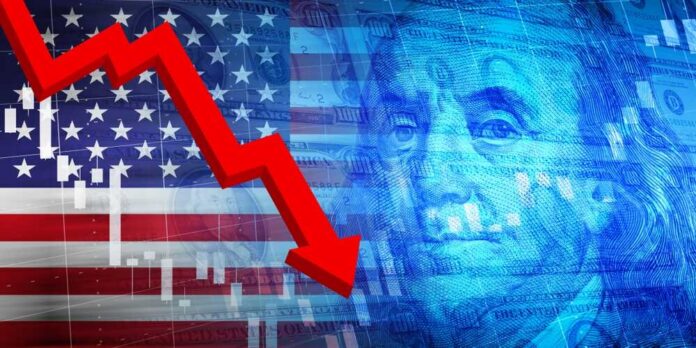
A veteran economist with 36 years in the field just said the stock market has never been more disconnected from the real economy in his entire career — and he has numbers to back it up.
Quick Take
- Moody’s Analytics chief economist Mark Zandi puts U.S. recession odds at 40%, nearly three times the historical baseline of 15%.
- Real job growth has nearly stalled, real disposable income is flat year over year, and real consumer spending has gone nowhere in 2026.
- Zandi argues the stock market’s AI-driven rally is masking serious economic fragility beneath the surface.
- He says recession is still avoidable, but only if Washington abandons broad tariffs, eases immigration enforcement, and resolves foreign-policy shocks.
The Number That Should Stop You Cold
Mark Zandi, chief economist at Moody’s Analytics, did not mince words in a recent interview: “40% is very elevated, very uncomfortable — it gives you a sense of how close I think things are to the edge here.” [1]
That 40% recession probability is nearly three times the historical average of roughly 15% he cited as a baseline. [5] For context, that baseline represents a normal, unremarkable economy humming along. Where we are now is not that.
What makes Zandi’s warning credible is that it is not built on vibes. He points to a specific convergence of softening indicators arriving at the same time: stalled job growth, flat real income, weak consumer spending, and a shrinking foreign-born labor force. [5]
Each one alone might be noise. Together, they form a pattern that historically precedes contraction. Zandi says he expects negative payroll months soon, and in his framework, that is typically where recessions begin. [5]
The Labor Market Is Weaker Than the Headlines Suggest
The April jobs report, released around the time of Zandi’s warning, showed payrolls remained positive, giving market bulls a reason to exhale. But Zandi’s argument is not about one month’s print.
He notes that foreign-born labor-force growth has dropped from 4-5% a year ago to a decline now, and that the overall labor force has flattened or shrunk since the start of the year. [5] A labor force that stops growing is an economy running out of fuel, not one that is accelerating.
Top economist sounds alarm on America’s 40% recession risk, warns stocks are disconnected from reality https://t.co/57286XAjZr
— FOX Business (@FoxBusiness) May 20, 2026
Real disposable income — after taxes and after inflation — is no higher today than it was a year ago. [1] Real consumer spending has been flat in 2026, with lower- and middle-income households absorbing the most stress. [5]
These are the consumers who drive the bulk of economic activity in America. When they stop spending, the economy does not drift sideways; it tips.
The Stock Market Is Telling a Very Different Story — and Zandi Says It Is Wrong
Here is where the argument gets genuinely provocative. Zandi stated plainly that in his 36 years as a professional economist, the stock market has never been more disjointed from the economy than it is right now. [1]
The rally is real, but he attributes it almost entirely to a narrow group of large hyperscaler and chip companies riding the artificial intelligence wave. [1] That is not broad economic health. That is a concentrated bet on one theme, and concentrated bets have a history of reversing hard.
Stocks are pricing perfection while the economy looks shaky. Mark Zandi says markets are increasingly disconnected from fundamentals, AI hype is doing heavy lifting, and recession odds stay at 40% over the next 12 months. Risk is the story. #stocks #economy pic.twitter.com/kIPFURdDnz
— geekopedia (@geekopediax) May 20, 2026
The dot-com comparison is uncomfortable but fair. In 2000, the Nasdaq carried the headline indices while the broader economy was already softening. The divergence between market prices and economic fundamentals did not last.
Zandi is not predicting a crash, but he says the market is pricing in perfection while the underlying economy remains fragile. [4] That gap matters, and it rarely closes in a pleasant direction.
Policy Is the Wildcard That Could Push This Either Way
Zandi is explicit that recession is not inevitable. He says the U.S. can still avoid it if policymakers get out of their own way. [4] Specifically, he warns that broad-based tariffs, heavy-handed immigration enforcement, and unresolved foreign-policy conflicts are “significantly raising the threat of recession.” [4]
He also modeled an oil-price threshold, noting that crude averaging near $125 per barrel in the second quarter alone would be enough to materially worsen the outlook — and called that scenario “not a stretch” given tensions in the Middle East. [3]
That framing is worth taking seriously on its merits. Tariffs function as a consumption tax on American households and a cost increase for American manufacturers.
Restricting labor supply through aggressive immigration enforcement tightens an already flat labor force. These are not abstract policy debates; they are direct inputs into the economic model Zandi is running.
The honest read of his warning is that Washington’s own decisions are the biggest variable in whether that 40% probability goes up or comes back down.
Sources:
[1] Web – Mark Zandi puts U.S. recession odds at 40%, warns economy is ‘on …
[3] Web – Moody’s Mark Zandi: Risk of recession was increases prior to war in …
[4] Web – Recession Risk Is ‘Rising Significantly,’ but US Can Still Avoid It
[5] YouTube – Why Mark Zandi Says the Economy Is “Fragile”