

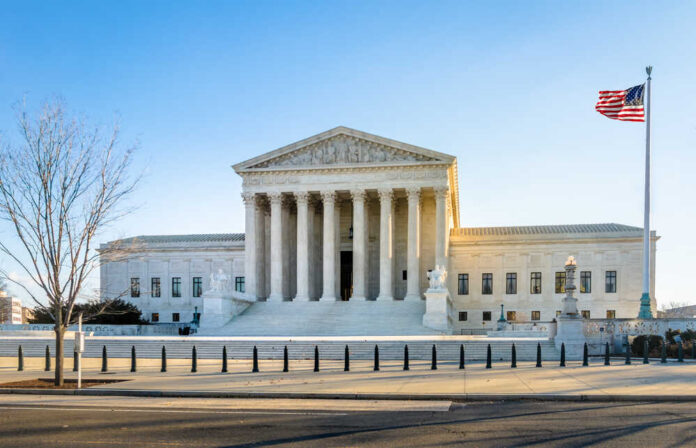
House Democrats blocked a Republican push to lock the Supreme Court at nine justices, keeping the door open to future size fights.
Story Snapshot
- The proposal would amend the Constitution to cap the Court at nine justices.
- Republicans advanced it to deter future “court packing,” but lacked supermajority support.
- The House vote fell short, so the amendment stalled for now.
- Debate revived the long history of Congress shaping Court size by law, not by the Constitution.
What the amendment said and why it mattered
The House considered language that would hardwire nine seats into the Constitution. The text was simple: one chief justice and eight associate justices, period. Sponsors argued this guardrail would stop a future Congress from adding seats to shift outcomes.
They pointed to public warnings about “court packing” and said a clear rule would cool the arms race. The goal was permanence, not a one-Congress statute that a later majority could undo.
Republican backers said the Court’s legitimacy needs a bright line. They cited the nation’s long run at nine seats since 1869 as a stable norm worth locking in.
They argued that rules that change with every election shred trust, and that judges must sit above the daily fight. Supporters in the Senate had echoed this case earlier, framing nine as a way to avoid endless escalation and to protect the Court’s standing with the public.
How the effort advanced, then hit the wall
House sponsors introduced the amendment early in the session and built a sizable list of cosponsors. The House Judiciary Committee moved it forward on a party-line vote, showing clear internal support. But constitutional amendments require two-thirds in both the House and the Senate.
That bar is high by design. Republicans did not have the numbers, and opponents held firm. When leadership forced the question to the floor, the vote missed the mark, and the measure failed to advance.
House Democrats on Wednesday overwhelmingly voted against a constitutional amendment to set the number of Supreme Court justices at nine. https://t.co/Xx6Rm1Mlb8
— The Washington Times (@WashTimes) September 2, 2026
The numbers game shaped everything. A statute can pass with simple majorities, but it can be flipped just as fast. An amendment, by contrast, requires broad buy-in and approval from three-fourths of the states.
That steep climb demands a coalition that extends beyond a single party. Reuters reported that the votes were not there, and that the path forward was “near-certain” to stall without Democratic support.
What opponents argued and what the record shows
Democrats framed the push as a partisan move to freeze a 6-3 conservative Court. Some also argued that Congress has the power to change Court size by law if future needs demand it.
Nonpartisan analysts at the Congressional Research Service note that scholars broadly agree Congress can alter the Court’s size by statute, and that many commentators prefer reforms other than expansion. That view treats nine as strong tradition, not a constitutional rule, unless amended.
Opponents also pointed to the nation’s past. The Constitution does not set the number of justices. Congress changed it several times in the 1800s. The current nine-seat setup dates to 1869.
The National Constitution Center recaps this history and shows that fights over size often track broader political clashes. That record cuts both ways: it shows Congress can act, and it warns that size fights can erode public trust if used for short-term gain.
How this fits the bigger constitutional picture
The core tension is simple. One side wants to lock a norm into the Constitution to prevent a spiral. The other side wants to keep legislative tools available for future problems.
The sponsors’ case aligns with values that prize stable rules, clear limits, and institutions shielded from raw power plays. Their critics say a rigid cap may box in future Congresses and treat a potential threat like a present crisis without hard proof of an active plan.
NEW: House Democrats block GOP-led constitutional amendment to lock Supreme Court size at 9 justices
212-206, short of the 2/3rds majority.
Every Dem but Don Davis voted NO; leaders whipped NO.
As Dem support to expand SCOTUS grows.
w/ @KyleAlexStewart https://t.co/uyCYsW63Rf
— Sahil Kapur (@sahilkapur) September 2, 2026
Two facts stand out after the vote. First, the House rejection does not change the current Court size; nine seats remain under existing law. Second, the political incentives that sparked this push remain. If either party sees a chance to tilt the Court, pressure to change the rules will return.
That is why a permanent cap appeals to many. They would rather settle the question now than test the nation’s patience later in a race to the bottom.
Sources:
congress.gov, reuters.com, dustyjohnson.house.gov, ms.now, constitutioncenter.org