

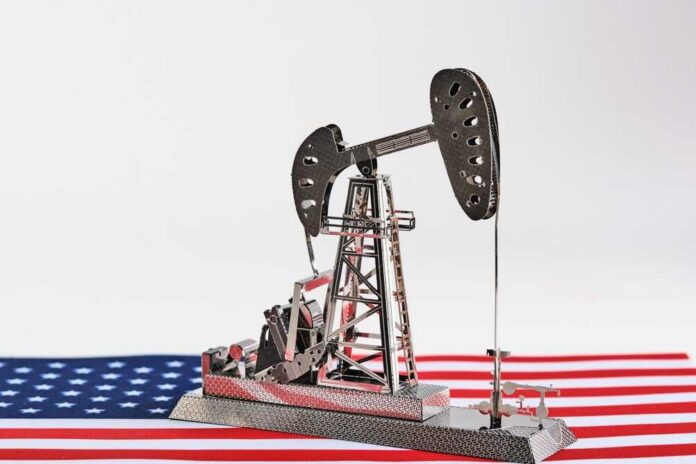
President Trump says the United States secured majority control over more than 65 billion barrels of Venezuelan oil, at no cost to taxpayers, in what he calls the biggest oil deal in history.
Story Snapshot
- Trump announced a U.S.–Venezuela agreement covering 65 billion barrels of proven oil reserves.
- The deal, he said, gives U.S. interests majority control with no taxpayer cost.
- Secretary of State Marco Rubio and Secretary of War Pete Hegseth helped broker the talks with Venezuelan counterparts.
- Venezuelan law still states the republic owns oil in the ground, shaping how “control” works.
What Trump Announced And Why It Matters
President Trump declared that the United States reached an agreement with Venezuela that grants majority U.S. control over more than 65 billion barrels of proven oil reserves. He framed it as “the biggest oil deal in world history” and stressed the deal carries no cost to American taxpayers.
He credited Secretary of State Marco Rubio and Secretary of War Pete Hegseth with helping broker the arrangement alongside Venezuelan negotiators and private businesses. Major outlets reported his statement and scale of the claim on the same day.
Trump says US has entered deal with Venezuela to take control of 65 billion barrels of oil reserves https://t.co/LZiLr2ysCY
— Boston 25 News (@boston25) August 29, 2026
The number itself is eye-popping. Sixty-five billion barrels would be larger than the current proved reserves of many oil-producing nations. It suggests a long runway for supply, refining deals, and strategic reserves planning.
For energy security hawks, the headline signals a shift from dependence on less friendly suppliers. For everyday drivers, the question is timing. Supply chains, rigs, and ports do not move overnight. Any price effect would trail investment, drilling, and shipment schedules that play out over years.
How “Control” Works Under Venezuelan Law
Venezuela’s constitution and oil laws keep ownership of underground oil with the republic, not private firms. The state oil company, Petróleos de Venezuela, must remain state-owned.
Contracts can grant operating rights, shares in joint ventures, or output at the wellhead, but the legal title to reservoirs stays public. That framework shapes deals. In practice, “majority control” usually means control over ventures, lifting rights, or revenues, not deeded ownership of oil in the ground.
That legal backdrop does not shrink the deal’s size; it defines its mechanics. If U.S.-aligned firms hold majority stakes in joint ventures or production contracts, they can set budgets, pick service partners, and decide timelines. Those decisions drive barrels to market. They also set standards on safety and transparency.
Sanctions, Licenses, And The On-Ramp To Oil Flows
United States sanctions on the Venezuelan oil sector have been the choke point since 2019. The State Department documented actions that named the state oil firm and limited trade, while issuing targeted licenses at times to allow specific projects to proceed.
Any new production and exports under this deal will rely on licenses, waivers, or a structured unwind that keeps pressure on bad actors while unlocking barrels. This approach links access to compliance benchmarks and market discipline.
Trump just secured a deal for 65 billion barrels of Venezuelan oil.
He says it will refill America’s Strategic Petroleum Reserve.
Experts: Don’t expect cheaper gas anytime soon.
Biggest oil deal ever or just another headline?#Venezuela #OilDeal pic.twitter.com/C7b02CmhrB
— Anna Zeller (@Az621421) August 31, 2026
Reuters reported the administration worked on a long-term access plan even before Trump’s announcement, aimed at securing portions of reserves and lowering import costs over time. That tracks with standard oil timelines. Field recovery takes capital, rigs, and steady rules.
Services crews must repair wells, restore power, and clear bottlenecks at upgraders and ports. If the deal holds and licenses flow, the United States could add reliable heavy crude supply that blends well with Gulf Coast refineries tuned for such grades.
What This Could Mean For Your Wallet
Energy prices follow global supply, shipping, and demand. A headline does not cut pump prices next week. New or revived Venezuelan output could ease balances in tight markets later. That softens spikes from wars, hurricanes, or strikes.
For the Strategic Petroleum Reserve, heavy barrels offer flexibility if refilled on favorable terms. The claim of no taxpayer cost points to private capital carrying risk, which aligns with market-first, America-first principles, if contracts protect U.S. interests.
The Strategic Stakes For The United States
Control over supply chains beats hope. This deal, as described, aims to pull key barrels into a U.S.-led orbit and away from rivals. It could weaken the leverage of hostile states and hedge against shocks.
It could also reward a post-crisis Venezuela that honors contracts and the rule of law. The proof will be steel in the ground and ships at berth. If governance and licensing stay steady, the payoff is energy security without new taxes, which most Americans would welcome.
Sources:
cnbc.com, abcnews.com, bbc.com, nbcnews.com, youtube.com, reuters.com