
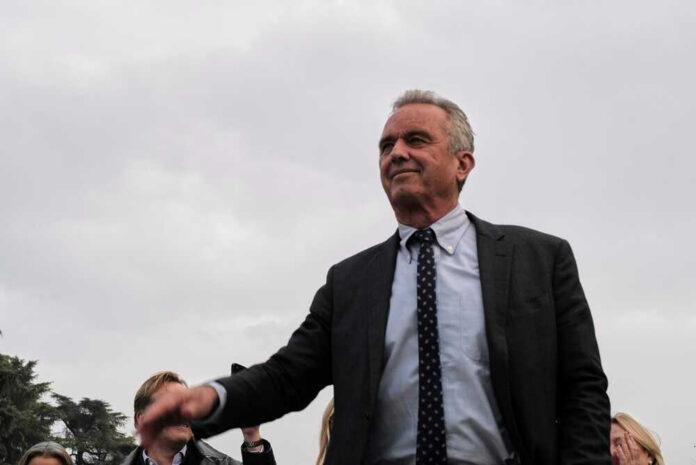
Health Secretary Robert F. Kennedy Jr. told a Michigan crowd that 500 million Arabs have never won a Nobel Prize, a claim that is flatly contradicted by the Nobel Prize’s own records.
Quick Take
- Kennedy told a Grand Rapids rally that Arabs “don’t produce science,” don’t win the Nobel, Fields, or Wolf prizes, and don’t produce literature.
- Multiple Arab laureates, including Ahmed Zewail, Naguib Mahfouz, and Omar M. Yaghi, directly disprove the claim.
- Kennedy blamed the Muslim Brotherhood for what he called centuries of stagnation, without citing supporting research.
- Civil rights groups and Middle East scholars called the remarks bigoted and factually wrong.
- The comments came during a Michigan campaign stop tied to a race involving an Arab-American candidate.
What Kennedy Actually Said Onstage
Kennedy made his remarks at a campaign event in Grand Rapids, Michigan. He said, “There’s 500 million Arabs in the world, and yet they don’t produce science. They don’t win the Nobel Prize. They don’t win the Fields prize. They don’t win the Wolf Prize. They don’t produce literature”. He named specific, well-known awards, which made his claim easy to check against public records.
Arabs 'don't produce science, they don't win the Nobel Prize… They don't produce literature' — RFK Jr
His statement sparked a heated reaction in the comments pic.twitter.com/fic76EzUjs
— RT (@RT_com) October 27, 2026
Kennedy didn’t stop at modern achievement. He claimed Arabs “were the first to make books” and that 13th-century Muslim princes held libraries bigger than all of Europe’s combined. Then he pointed to a modern culprit for the supposed decline, saying “all of that tradition has been destroyed by the Muslim Brotherhood,” which he claimed produces only “hatred, war, and victimization”.
The Nobel Record Tells A Different Story
Egyptian-American chemist Ahmed Zewail won the 1999 Nobel Prize in Chemistry for his pioneering work in femtochemistry. Egyptian novelist Naguib Mahfouz won the 1988 Nobel Prize in Literature, becoming the first Arabic-language writer to receive it, according to the Nobel Prize’s own press release. Those two names alone contradict Kennedy’s claim about science and literature in one stroke.
The list keeps growing. Moungi Bawendi and Omar M. Yaghi both won Nobel Prizes in Chemistry, in 2023 and 2025. Mohamed El Baradei and Tawakkol Karman won Nobel Peace Prizes, and Lebanese-born mathematician Michael Atiyah won a Fields Medal. An Associated Press fact-check laid out these names point by point, calling Kennedy’s claim a “reality check” against documented history.
Backlash From Scientists And Civil Rights Groups
Former Centers for Disease Control and Prevention official Nirav Shah called Kennedy “unserious and incurious about the world.” University of Oklahoma Middle East studies professor Samer S. Shehata described the comments as “incredibly disappointing” and “bigoted”. Al Jazeera reported that critics broadly labeled the remarks racist, Islamophobic, and factually inaccurate, citing both historic and modern Arab achievement.
The Council on American-Islamic Relations went further, calling the comments “a textbook display of unvarnished racism and bigotry,” a reaction that spread quickly across social media alongside clips of the rally. The setting mattered too. Kennedy spoke in a state with a large Arab-American population, during a race that includes Arab-American candidate Abdul El-Sayed, adding a political edge to an already combustible comment.
A Cabinet Secretary’s Words Carry Extra Weight
Kennedy isn’t a random commentator. He runs the nation’s top health agency, which gives his statements about science an air of authority they haven’t earned here. Broader research on Arab-world science points to real challenges, like low research funding and brain drain, but those are institutional problems, not proof that an entire ethnic group lacks ability or output. Painting a billion-person civilization as incapable of science or literature isn’t just wrong on the facts. It’s the kind of sweeping generalization conservatives have long criticized when aimed at any group, and it deserves the same scrutiny here.
No single remark fixes a complicated history of Middle Eastern science funding, war, and politics. But Kennedy didn’t offer a nuanced critique of institutions. He offered a blanket insult, backed by no data, no sources, and no definition of who counts as Arab. The Nobel committee’s own archives did the fact-checking for everyone else.
Sources:
newsweek.com, apnews.com, al-monitor.com, soapcentral.com, bostonglobe.com, huffpost.com, boston25news.com