
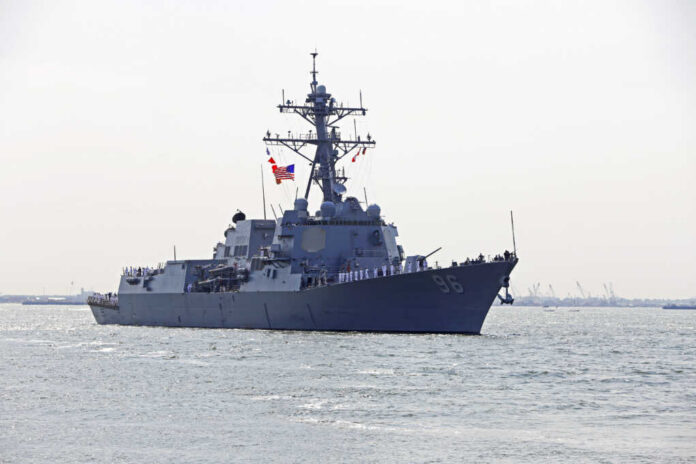
For four days in contested waters, a front-line U.S. destroyer went dark — and that should focus every mind.
Story Snapshot
- The USS Benfold lost power for four days in the South China Sea after a generator-related engineering casualty, the Navy said.
- No injuries were reported; the crew leaned on help from nearby U.S. ships while damage control teams worked.
- The incident adds to a pattern of power casualties in the Indo-Pacific that tie directly to readiness.
- The Navy is investigating the root cause; “engineering casualty” is a broad category, not a verdict.
What happened to USS Benfold, and when
The U.S. Navy said the guided-missile destroyer USS Benfold suffered an engineering casualty involving its generators on July 24 while operating with the USS George Washington carrier group in the South China Sea. The failure led to a loss of power that lasted four days.
A Seventh Fleet spokesperson confirmed the timeline and described steady, professional work by the crew as the event unfolded. The Navy reported no injuries during the incident, which remains under investigation.
A power outage aboard a U.S. Navy destroyer in the South China Sea last month deprived the crew of drinking water, hot meals, functioning toilets and air conditioning for four days. pic.twitter.com/ZEEptraDl5
— Breaking911 (@Breaking911) August 19, 2026
Power loss on a modern destroyer blinds more than lights. Without electricity, ship services like air conditioning, most toilets, the galley, and potable water production are limited or offline.
Reports described sailors enduring heat and rationed services while engineers fought to restore critical systems. Nearby U.S. vessels supported with meals and assistance. The account underscores the layered risk when a warship cannot move or make water in tropical seas crowded with rivals and watchers.
Why “engineering casualty” matters — and what it does not say
The Navy’s term “engineering casualty” tells us something broke in the plant but not why. It can cover component wear, a fault in power distribution, a maintenance lapse, operator error, or a chain reaction inside the electrical grid.
The service has said the root cause is being investigated. That clarity gap is normal at this stage, and it is why investigators collect data logs, inspect failed parts, and interview watch teams before drawing conclusions.
The label also cues a response playbook. Crews shift to casualty control, isolate faults, and protect remaining systems. Commanders call for help early, especially in busy waters.
The metrics that matter in this window are time to assess, time to stabilize, and how well the ship stays safe. By those measures, the Navy’s statement points to a competent response by the Benfold’s crew and the strike group, even as the outage stretched across days.
The readiness lens: one ship, bigger stakes
This breakdown did not happen in a vacuum. Earlier this year, the destroyer USS Higgins lost power and propulsion for hours in the Indo-Pacific after what the Navy called an electrical-system casualty.
That event also ended without injuries but raised questions about the strain on forward ships and the resiliency of their power plants under load. When two front-line destroyers in the same region face power failures in one year, readiness moves from talking point to scoreboard.
A Navy destroyer went four days without power in the South China Sea last month, leaving sailors aboard without toilets, air conditioning, galley service and potable water, according to the U.S. Navy's 7th Fleet.
The USS Benfold, an Arleigh Burke-class guided-missile destroyer,… pic.twitter.com/ePL29c0K4K
— WAVY TV 10 (@WAVY_News) August 19, 2026
Arleigh Burke-class destroyers carry the pace of today’s fleet. They deploy hard, then sit in shipyards for major overhauls. A Congressional Budget Office estimate said destroyers would spend roughly a quarter of their service lives in maintenance.
That number captures the cost of keeping aging hulls lethal and safe. The Benfold’s outage fits that larger math: modern combat systems demand robust power, and any weak link — a generator, a breaker, a sensor — can sideline the whole ship.
What aligns with common sense and national priorities
Americans expect two things from their Navy: show up and work when it counts. The Benfold event supports a plain view. The crew did its job under pressure, and no one was hurt. That is good news. The outage lasting four days in the South China Sea is the hard news.
That duration points to a system-level fault that outpaced onboard spares and fixes. The answer is not a press release. The answer is parts, training, and time on task — then rapid follow-through when engineers flag repeat risks.
Taxpayers fund a fleet to deter war first, and to win if needed. Power resilience is not a boutique feature; it is the backbone of every radar picture, missile shot, and lifesaving pump. If the investigation finds a design issue, fix it across the class.
If maintenance timing slipped, pull it left. If a part failed early, change the spec and stock more of them forward. That is how you turn a bad day at sea into tighter readiness and credible presence.
What to watch next
Expect the Navy to publish a preliminary finding that narrows the failure path in the power system. Watch for a fleet advisory to other destroyers on inspections or part swaps, which is a tell that the cause has broader touchpoints.
Look for updates on how the strike group adjusted roles while Benfold was offline. The best outcome is simple: ship fixed, lessons shared, and fewer headlines about power losses in the world’s most watched waters.
Sources:
cbsnews.com, stripes.com, facebook.com, linkedin.com, timesofindia.indiatimes.com