
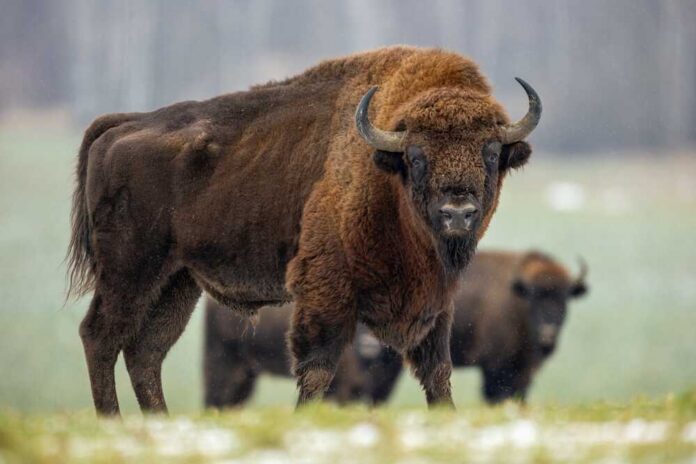
The most dangerous thing in Yellowstone that day was not the bison’s horns, but human assumptions about “safe” nature.
Story Snapshot
- A 12-year-old was injured by a bison near Yellowstone’s Mud Volcano boardwalk.
- Bison hurt more people in Yellowstone than any other animal, despite clear distance rules.
- Officials released almost no detail, feeding media spin and blame games.
- The real pattern points to human behavior, not a “rogue” park or monster animal.
A child, a bison, and a split-second reminder Yellowstone is not a zoo
Yellowstone National Park says a 12-year-old visitor was injured by a bison around 9:15 a.m. near the Mud Volcano area, just north of Fishing Bridge, and taken to a nearby hospital for treatment.[4]
Officials have not released the child’s condition or exactly how the encounter unfolded, only that the incident remains under investigation.[6]
On paper, that sounds like a freak accident. In context, it fits a long, uncomfortable pattern of people and powerful wildlife colliding in predictable ways.[7]
12-year-old hospitalized after being injured by bison in Yellowstone National Park https://t.co/CLJoovR849 pic.twitter.com/IpuzbVvlQ7
— New York Post (@nypost) June 28, 2026
National Park Service reminders after the incident were blunt: wildlife in Yellowstone are wild and unpredictable, and visitors must stay at least 25 yards from large animals like bison, elk, moose, and coyotes, and 100 yards from bears, wolves, and cougars.[4][6]
Rangers stress that if an animal approaches, people should move away to maintain that distance, never crowd, touch, or feed the animal.[4][9] That is not fine print; it is the core safety rule that determines whether a vacation ends with photos or with an ambulance.
What we know, what we do not, and why the void matters
Officials have not said how close the child was, whether adults were nearby, or if the bison charged from a distance.[6] They also have not described the type or severity of the injuries, which makes it impossible for outsiders to judge whether the current precautions at Mud Volcano are sufficient.
That silence creates an information vacuum. Critics quickly fill it with claims of park negligence, while others assume the family ignored warnings. Both sides are guessing, because the facts we need most are still locked in the investigation file.
Media coverage leans hard on the phrase “12-year-old injured,” often without explaining the long history behind these events. Some stories highlight Yellowstone’s own warning that bison are unpredictable, can run three times faster than humans, and will defend their space when threatened.[6]
That description is accurate, but the way it is framed can shift focus from human choices to a vague idea that bison might attack at any time, distance be damned. That feeds the notion that no amount of personal responsibility matters, which runs straight against the data.
The stubborn math of bison injuries and human behavior
Since 1980, bison have injured more pedestrian visitors in Yellowstone than any other animal.[7][8] A Centers for Disease Control and Prevention review of 2015 injuries found that every single bison encounter that ended in injury happened because people failed to maintain the required 75-foot distance then in effect.[7]
Many were taking photos within 3 to 6 feet of the animals, some turning their backs for selfies. In another study of 2000–2015 cases, 80 percent of injured people had actively approached bison, and almost half were photographing them.[2]
‼️ BISON INJURY: A 12-year-old was hospitalized after being injured by a bison on Friday morning while visiting Yellowstone National Park. This is the first reported bison attack in Yellowstone this year.
Read more: https://t.co/gV7bIICZGQ pic.twitter.com/OEoNg3N7F6— FOX Weather (@foxweather) June 27, 2026
Those numbers matter more than feelings. After Yellowstone ramped up outreach in the 1980s, average bison injuries dropped to under one per year in the 2010–2014 period.[8]
Education worked for most visitors, but not for everyone. A small slice still walked too close, crowded in groups, or refused to back away.[2]
The lesson suggests the government can post signs, hand out flyers, and draw lines on the boardwalk, but it cannot fix bad judgment. Freedom in wild places comes with the duty not to act like the rules are optional.
Responsibility, risk, and what this case should change
This specific incident sits at an awkward crossroads. On one hand, Yellowstone has hammered the same message for decades: stay 25 yards from bison, move away if they close the gap, and understand that these animals will defend their space.[4][9]
On the other hand, the park has not yet shown the public what signage, ranger presence, or crowding looked like at Mud Volcano at that exact moment.
Without those details, critics are free to say the park traded strict enforcement for tourism flow, while others blame “stupid tourists” with nothing but stereotypes.
The fairest reading, based on years of data, is this: bison are not ambush predators; they respond when people get too close or refuse to move.[7][2]
That does not mean this child or their parents acted recklessly, only that past injuries almost always trace back to human decisions, not random animal rage.
If the final report shows poor signage or design in that area, Yellowstone should fix it. But if it shows familiar behavior—crowding, photos, or slow retreat—then we should stop pretending nature failed and admit the real problem rides in on two legs.
Sources:
[2] Web – 12-year-old injured by bison at Yellowstone National Park – 6ABC
[4] YouTube – Bison injures 12 year old visitor in Yellowstone near Mud Volcano
[6] Web – A child visiting Yellowstone National Park in Wyoming was injured …
[7] Web – Yellowstone – (NEWS RELEASE) A 12-year-old visitor was injured …
[8] Web – 12-year-old injured by bison in Yellowstone National Park. https …
[9] X – Yellowstone National Park