

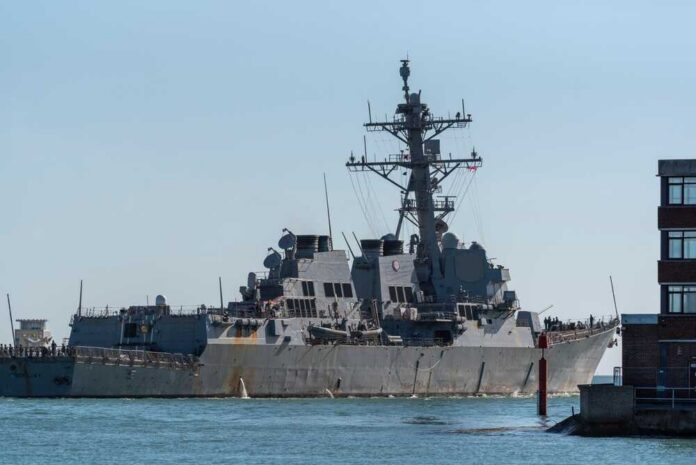
U.S. Southern Command says a Sunday strike sank a low-profile boat on a known drug route and left two people dead.
Story Snapshot
- Southeastern Pacific strike executed August 23 by Joint Task Force Western Hemisphere.
- Target described as a low-profile vessel along established narco-trafficking routes.
- Two killed; first publicly announced maritime strike in roughly two months.
- Action fits a months-long campaign against alleged narcoterrorist boats at sea.
SOUTHCOM’s Account Of The Strike
U.S. Southern Command reported that on August 23, Joint Task Force Western Hemisphere conducted a lethal strike on a low-profile vessel in the Eastern Pacific Ocean. The command said the boat was operating along established narco-trafficking routes.
The operation fell under the direction of General Francis L. Donovan. The command framed the action as part of a larger effort to disrupt maritime smuggling networks. The announcement did not include the vessel’s flag, cargo details, or precise location.
"This operation is a clear and decisive reminder that SOUTHCOM is taking the fight directly to the cartels."
On August 23, under #SOUTHCOM Commander Gen. Francis L. Donovan’s direction, Joint Task Force Western Hemisphere executed a lethal kinetic strike on a low-profile vessel… pic.twitter.com/aIw1qn36gd
— U.S. Southern Command (@Southcom) August 24, 2026
Reuters reported that two people were killed in the weekend strike and described it as the latest in a series of similar operations this year.
Multiple outlets noted this was the first publicly announced strike in about two months, which suggests a pause or slower operational tempo in midsummer before the resumption this week. Public reporting did not identify the individuals on board. No U.S. casualties were reported in the action.
Why A “Low-Profile” Vessel Matters
Cartels rely on low-profile boats because they ride low in the water, reduce radar returns, and blend with waves. Crews often move at night and hug long sea lanes that cut west from Central and South America toward deep-water transfer points.
U.S. forces watch these routes using aircraft, ships, and partner reporting. When commanders state a craft matched a known smuggling profile on a known route, they are tying the decision to established patterns that have supported many past interdictions.
Southern Command has cast these at-sea actions as part of a wider campaign that treats cartel networks as transnational threats, not just street-level crime rings. That framing signals intent: disrupt logistics, raise risk, and force traffickers to shift to costlier methods.
In plain terms, take out the delivery truck, not just chase the driver on shore. The goal is to make the sea lane a dead end for cartel supply chains and their enforcers.
How This Fits The Broader Campaign
Public records and reporting show dozens of maritime strikes since early phases of the effort, with fatalities reported across incidents. The trend line points to a sustained strategy that mixes military tools with counter-narcotics aims.
News coverage in recent months has placed the tally in the hundreds across the campaign, reflecting repeated engagements against small boats flagged as smuggling assets. That scale explains why each new strike gets weighed against a pattern, not as a one-off.
US Strike on Alleged Drug Boat Kills Two@LibertarianInst
US Southern Command announced it conducted a strike on a vessel in the Eastern Pacific Ocean and killed two people suspected of trafficking narcotics.
“Joint Task Force Western Hemisphere executed a lethal kinetic… pic.twitter.com/Qhh6GKDXQQ
— Kyle Anzalone (@KyleAnzalone_) August 25, 2026
NPR’s overview noted that debate continues over how well these strikes affect overdose deaths at home, given that fentanyl often moves overland from Mexico rather than by sea.
Even so, removing maritime nodes can still matter by straining broader supply chains. From a security lens, decisive pressure on cartels aligns with a core duty of government: shield citizens from lethal narcotics, transnational crime, and the violence that follows both.
The Legal And Policy Crosscurrents
United Nations human rights officials, Human Rights Watch, and others have criticized the campaign, arguing that repeated lethal force at sea risks violating international law and human rights law. They frame these operations as killings outside normal legal process.
Southern Command and administration officials, by contrast, present the targets as unlawful combatants in an armed conflict against cartel-linked threats, which they say justifies lethal action when needed to stop hostile actors at sea.
Reasonable people can debate the best legal frame, but the practical stakes are clear. Cartels use the ocean as a highway. If that highway feels safe, smugglers will surge volume. If it feels dangerous, they lose time, money, and product.
That pressure can buy space for law enforcement and partner nations to hit networks ashore. The American public values strong borders, safe communities, and order at sea. Focused strikes that break trafficking routes fit those aims when they are precise, lawful, and effective.
Sources:
apnews.com, southcom.mil, x.com