

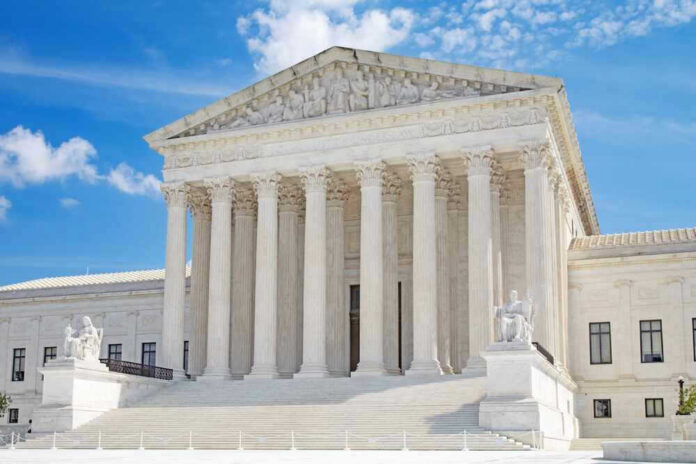
The Supreme Court has finally drawn a hard line in school sports, ruling that states can protect girls’ and women’s teams based on biological sex.
Story Snapshot
- Supreme Court says Title IX allows states to keep girls’ sports based on biological sex, not gender identity.
- Justice Brett Kavanaugh’s 6-3 opinion backs safety and fair competition as key reasons to separate sports by sex.
- Ruling shields similar laws in more than two dozen states and aligns with President Trump’s Title IX agenda.
- Liberal justices and activist groups call the decision a “devastating” setback and vow more lawsuits.
Supreme Court Confirms States Can Protect Women’s Sports
The Supreme Court ruled that state laws in West Virginia and Idaho that keep transgender girls and women off female school teams do not break the Constitution or Title IX. Justice Brett Kavanaugh wrote the 6-3 majority opinion, joined by Chief Justice John Roberts and four other conservative justices.
He said Title IX’s word “sex” means biological sex, not gender identity, and that Congress in 1972 could not have meant anything else. That single line closes years of legal games that tried to stretch the law beyond its plain text.
BREAKING: The Supreme Court upholds state laws banning transgender girls and women from school athletic teams. pic.twitter.com/PrGSPDiedN
— NEWSMAX (@NEWSMAX) June 30, 2026
By backing these laws, the Court signaled that long-standing rules that separate boys and girls in sports remain lawful when they are tied to real physical differences and to fairness for female athletes. The Court accepted the states’ argument that sex-based classifications are allowed when they are closely related to protecting equal athletic chances and safety for girls and women.
This means states can set boundaries in school and college sports so girls do not lose medals, scholarships, or roster spots to competitors who went through male puberty.
Title IX Returns to Its Original Meaning: Biological Sex
Title IX was passed to stop schools from shutting girls out of sports and other programs simply because they were female. Congress later allowed separate boys’ and girls’ teams as long as schools kept equal access to the full athletics program.
The new ruling says that structure is not only legal but expected, because biological sex affects speed, strength, and power in obvious ways. Idaho’s lawyers told the Court that men are generally faster, stronger, and more muscular than women, and the majority treated that as common sense.
This decision also pushes back on lower courts and activists who tried to treat “sex” and “gender identity” as the same in education law. Earlier rulings in other circuits and policy papers claimed Title IX must cover gender identity and let transgender athletes compete in line with that identity.
The Supreme Court has now put a clear brake on that reading in the sports setting, anchoring the law to biology. That gives schools and parents a stable rule: girls’ sports are for girls, based on sex at birth, with states free to refine details as they study safety and fairness concerns.
Impact Across 27 States and Trump’s Executive Order
Idaho passed the first statewide ban on transgender athletes in female school sports in 2020, with West Virginia following in 2021. Since then, Republican-led states across the country have adopted similar protections, and by early 2026, laws or regulations in about 27 states limited transgender girls’ and women’s participation on female teams.
Arizona’s “Save Women’s Sports Act” is one example of these measures now reinforced by the Court’s ruling. The decision effectively shields this growing set of laws from broad federal attack under Title IX and the Equal Protection Clause.
The ruling also lines up with President Trump’s 2025 executive order that told schools and athletic groups to recognize sex based on reproductive biology and genetics at birth when deciding who can play in girls’ and women’s sports.
That order directed federal agencies to update Title IX rules, enforce them against schools, and even cut grants from programs that ignored biological sex in team placement.
With the Supreme Court now confirming that Title IX permits sex-separated teams rooted in biology, the Trump administration has firm legal ground to keep pressing agencies and funded schools to follow this standard nationwide.
Fairness, Safety, and the Coming Legal Fights
Justice Kavanaugh highlighted safety and competitive fairness as the “touchstones” for sex-based limits in athletics. He noted that girls and women can suffer losses that matter, like missing out on medals, records, and college spots, if forced to compete against athletes with male physical advantages.
More than 100 athletes, coaches, and parents, including nearly three dozen Olympians, backed this view and urged the Court to keep equal opportunity for female athletes front and center. For many mothers and fathers, this ruling feels like a long overdue defense of their daughters’ hard work.
SCOTUS Upholds Transgender Sports Bans
The Supreme Court upheld state bans on transgender athletes in girls' and women's sports, siding with West Virginia and Idaho in two closely watched cases.
Justice Brett Kavanaugh, writing for the majority, said that states may set… pic.twitter.com/RAUb0q4mhu
— ronald ham (@ronaldham15) July 1, 2026
Liberal justices Sonia Sotomayor, Elena Kagan, and Ketanji Brown Jackson dissented in part, arguing that some transgender athletes should still be able to bring constitutional challenges, especially when medical treatments may change physical traits.
The American Civil Liberties Union, which represents the athletes in these cases, called the ruling “devastating” and vowed to keep fighting in lower courts. Ongoing lawsuits in more than twenty states mean this battle is not over, even though the high court has set the main rule for school sports policy.
Media Spin Versus Constitutional Reality
Major outlets quickly framed the decision as a “major blow” to lesbian, gay, bisexual, transgender, and queer rights and a defeat for transgender individuals. That language ignores what the Court actually said: states may protect female athletes while still allowing schools to decide how to treat other questions about gender identity and inclusion.
The ruling does not bar transgender students from all sports; it stops them from taking spots on girls’ and women’s teams where sex-based differences would erase the equal footing Title IX promised to young women.
For conservatives, the deeper story is about the Constitution and limited government. The Court refused to rewrite a 1972 statute to follow modern activist trends and instead left room for local control, allowing states and school systems to set policies within clear guardrails.
At the same time, it confirmed that federal civil rights law cannot be used as a weapon against the very women it was meant to lift up. That balance—strong protection for girls, respect for the text of the law, and room for democratic debate—is a significant win for parents, athletes, and anyone who wants fair play to mean what it says.
Sources:
apnews.com, nytimes.com, nbcnews.com, youtube.com, facebook.com, supremecourt.gov, mapresearch.org, ogletree.com, nwlc.org, wjlgs.law.wisc.edu, bestcolleges.com